You might have been diagnosed with irritable bowel syndrome (IBS) recently, and maybe the treatments are not working for you. You’re in pain, you feel groggy, or perhaps you have had abdominal surgery in the past and now have persistently stringy stool (pencil-thin, narrow, or run-like poop). Let’s walk you through what you know before accepting an IBS diagnosis.
How do doctors usually diagnose IBS from stringy poop and abdominal pain?
When irregular bowel movements such as stringy poop persist or are accompanied by pain or other symptoms, medical professionals will perform a physical examination, which may include
- Pelvic and rectal exams
- Looking at your medical history
- Performing diagnostic tests for an underlying medical disorder.
They may:
- Test saliva, blood, and urine to look for signs of infection or inflammation
- Perform scans such as CT, MRI, X-ray, ultrasound, colonoscopy, or endoscopy.
If these tests do not provide answers, they may investigate further with tests many people have never heard of, such as:
- Gastrointestinal barium contrast radiography
- Gastric emptying scintigraphy
- Antroduodenal manometry
- Or wireless motility tests.
These tests can rule out conditions such as:
- Hemorrhoids
- Diverticulitis
- Ovarian cysts
- Endometriosis
- Polyps
- Cancer and other conditions
When no other cause is apparent, clinicians may look at the available information and evidence and conclude that IBS is the cause of the symptoms. IBS is not life-threatening, but it is a very real gastrointestinal condition that can seriously negatively impact quality of life.
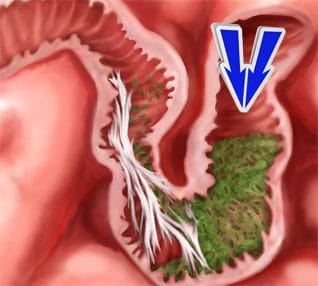
For people who have stringy poop, abdominal pain, and other symptoms caused by abdominal adhesions, treatments for IBS can actually make symptoms much worse. Current treatment options for IBS include dietary changes such as increasing fiber, exercise, medications and supplements, and cognitive-behavioral techniques to minimize anxiety.
Because slow digestion can be a problem for people with abdominal adhesions, medications or supplements used to control diarrhea associated with IBS can worsen this problem. On the other hand, for cases with diarrhea in patients with abdominal adhesions, there is already inadequate space in the GI tract for the normal passage of food and digested material. As such, soluble fiber supplements or fiber-rich foods that cause stool to bulk can be a real problem. Fiber can increase the risk of bowel obstruction or make a partial bowel obstruction become a total bowel obstruction.
Certain types of exercise and medications or supplements that stimulate the digestive system can result in nightmarish levels of pain for people with abdominal adhesions because the glue-like bonds throughout their abdominal cavity inhibit the natural movement and function of organs, muscles, and other structures.
Can I tell my doctor that the IBS treatment isn’t working?
Yes! Absolutely. When you know that you are in as much pain as you say you are and that IBS treatments are causing more harm than good, this can be an incredibly demoralizing situation, but definitely ask your doctor and seek other opinions if necessary. You may need to go above and beyond to take charge of your health and advocate for yourself. Most health care providers do their best to accurately diagnose and treat their patients, referring them to specialist after specialist in an attempt to find answers.
What is available to treat abdominal adhesions?
When it comes to abdominal adhesions, even the best doctors find themselves in quite a dilemma. Unless there is a significant partial or total bowel obstruction detected in a scan, the only way they can diagnose abdominal adhesions is to do a laparoscopy or laparotomy. Unfortunately, either one of these procedures or even performing adhesiolysis surgery (surgery to release adhesions) will likely result in the body forming even more adhesions.
For some people, the results are traumatic, with each surgery leading to more adhesions and more surgery and even more adhesions, and so on. Pain management medications and hospitalization for every bowel obstruction episode are treatments that only temporarily improve the patient’s quality of life. These traditional treatments are unsustainable and ineffectual ways to deal with abdominal adhesions.
There is a better way: A Clear Passage®
Not only is decreasing or eliminating abdominal adhesions without surgery a possibility, but it is also a probability with the Wurn Technique®. This treatment, although non-traditional, is not some experimental quackery. Scientific results have been published in trusted, peer-reviewed medical journals, demonstrating its effectiveness shows that it is the leading form of soft tissue treatment that removes adhesions or scar tissue.
With the Wurn Technique®, highly trained and certified physical therapists use their hands and fingers to pull apart adhesions non-surgically, like pulling apart the run in a three-dimensional sweater or pulling out the strands of a nylon rope. Although the treatment is sometimes referred to as a massage, it is more of an intensive, deep-pressure, soft-tissue physical therapy.
Unlike surgery, this therapy does not appear to create new adhesions, which is a major advantage for anyone who suffers from abdominal adhesions.
Walk in or call today!

Begin your journey.
Call or schedule a phone consult at no cost to you.