Category: Hydrosalpinx Treatment

  • Causes of Blocked Fallopian Tubes

    Causes of Blocked Fallopian Tubes

    High FSH, Only One Tube, the Other Blocked with Hydrosalpinx
, Three Children Conceived Naturally after CP Therapy alone

    Blocked fallopian tubes are a common cause of female infertility, preventing the egg from traveling down the tube to meet the sperm and be fertilized. Various factors and conditions can lead to this issue:

    Pelvic Inflammatory Disease

    Pelvic Inflammatory Disease (PID): This infection of the reproductive organs can cause scarring or damage to the fallopian tubes. 

    Inflammatory Pelvic Disorder and Its Impact on Fallopian Tubes

    Inflammatory Pelvic Disorder (PID) is a serious infection of the female reproductive organs, including the uterus, fallopian tubes, and ovaries. It’s often caused by sexually transmitted infections (STIs), such as chlamydia or gonorrhea, that ascend from the vagina or cervix into the reproductive organs. PID can lead to severe and lasting consequences for reproductive health, one of the most significant being the blocking of the fallopian tubes.

    The inflammation caused by PID can result in scar tissue, known as adhesions, forming on the fallopian tubes. This scar tissue can block the tubes, preventing the egg and sperm from meeting, which can lead to infertility. In some cases, PID may cause the tubes to become partially or completely blocked, significantly reducing the likelihood of natural conception. Additionally, women with a history of PID are at increased risk of experiencing ectopic pregnancies, where a fertilized egg implants outside the uterus, often in the fallopian tubes, due to the blockage preventing the egg from reaching its proper location in the uterus.

    Early diagnosis and treatment of PID are crucial to prevent the development of scar tissue and maintain fertility. Antibiotics are typically used to treat the infection, but in cases where significant scarring has occurred, surgery may be recommended to remove the blockage or fallopian tubes. Clear Passage® is just as effective as surgery at unblocking fallopian tubes and is all-natural (no surgery and no medication). 

    In the LEFT IMAGE (Before Therapy), dye enters the white area showing the inner walls of the uterus, but cannot exit (shown in red circles); these tubes are totally blocked.

    In the RIGHT IMAGE (After Therapy), dye fills the uterus, then exhibits ‘free spillage’ as it pours out of both fallopian tubes (shown in green circles); these tubes are wide open, capable of pregnancy.


    Endometriosis

    Endometriosis: A condition where tissue similar to the lining inside the uterus grows outside it, potentially blocking the fallopian tubes.

    Endometriosis Stages and Effects on Fallopian Tubes


    Previous Surgery

    Previous Surgery: Surgeries involving the abdomen or pelvis, including cesarean section, can lead to scar tissue that blocks the tubes.

    Impact of Previous Surgeries on Fallopian Tubes

    Previous surgical interventions in the abdomen or pelvis can inadvertently affect the fallopian tubes, leading to blockages that impact fertility. Surgeries such as appendectomies, surgeries for ectopic pregnancies, cesarean sections, or any pelvic or abdominal surgery can result in the formation of scar tissue, known as adhesions. These adhesions can develop as the body’s natural response to healing from surgery, but they can cause the fallopian tubes to become blocked or distorted. The risk of blockage increases with the extent of the surgery and the amount of scar tissue formed, which can interfere with the egg’s ability to travel through the fallopian tubes to meet the sperm.

    Read “How to Tell if You Have Adhesions After C-Section” for more details on cesarean section scar tissue.
    Moreover, surgeries that directly involve the reproductive organs, such as ovarian cyst removal or treatment for endometriosis, carry a higher risk of affecting the fallopian tubes. In some cases, the surgical procedure itself may require the cutting, removal, or manipulation of the fallopian tubes, which can lead to partial or complete blockages. These blockages prevent sperm from reaching the egg or the fertilized egg from moving down to the uterus, thereby affecting fertility. Early and effective post-surgical care, along with minimally invasive surgical techniques, can help minimize the formation of scar tissue and preserve fallopian tube function. If you are diagnosed with blocked fallopian tubes or hydrosalpinx due to scar tissue, Clear Passage® ® has been shown to open blocked tubes nearly 70% of the time, with many women becoming pregnant after treatment.

    “You succeeded in breaking up adhesions that blocked my tubes and in such a short amount of time. The tests confirm this and I was even able to achieve a pregnancy all because of your remarkable work.”

    Chandra

    Ectopic Pregnancy

    Ectopic Pregnancy: A pregnancy that occurs in the fallopian tube rather than in the uterus can damage or block the tubes.

    Ectopic Pregnancy and Its Impact on Fallopian Tubes

    An ectopic pregnancy, also known as an ectopic gestation, occurs when a fertilized egg implants and grows outside the main cavity of the uterus, most commonly in one of the fallopian tubes. This condition not only poses immediate health risks to the pregnant individual but also has long-term implications for the fallopian tubes and fertility. During an ectopic gestation, the growing embryo can cause the fallopian tube to stretch and possibly rupture, leading to internal bleeding, severe pain, and, in some cases, life-threatening situations that require emergency medical intervention.
    The treatment for an ectopic pregnancy often involves medication or surgery, depending on the gestation’s size and location, as well as the individual’s overall health. Surgical treatment may include the removal of the ectopic pregnancy and, if necessary, part or all of the affected fallopian tube. This procedure can result in scar tissue formation within the remaining parts of the tube, potentially leading to a blockage. Such blockages hinder the normal passage of eggs from the ovaries to the uterus, thereby affecting future fertility. In cases where an ectopic pregnancy has occurred, the risk of having another ectopic gestation increases, making it crucial for individuals to be closely monitored in subsequent pregnancies. In cases where an ectopic pregnancy has caused an adhesion and narrowed a fallopian tube, Clear Passage® Therapies have been shown to be an effective method for opening the blocked tube.


    Fibroids

    Fibroids: These benign tumors can grow in the uterus and block the fallopian tubes.

    Fibroids and Their Role in Fallopian Tube Blockages

    Fibroids, or fibroid myomas, are benign tumors that develop within the muscle tissue of the uterus. These growths are among the most common non-cancerous tumors in women of reproductive age and are often associated with fibroid disease, a condition characterized by the presence of one or more fibroids. While fibroids can vary greatly in size, number, and location within the uterus, their impact on a woman’s reproductive system can be significant, particularly when they lead to the blockage of the fallopian tubes.
    The mechanism by which fibroids cause fallopian tube blockages involves their physical presence and growth within the uterus. Large fibroids, especially those growing on the outer surface of the uterus or within the uterine wall (intramural fibroids), can exert pressure on the adjacent fallopian tubes, obstructing the passage through which the egg travels from the ovary to the uterus. This obstruction can prevent fertilization or interfere with the embryo’s ability to reach the uterus, leading to fertility issues or an increased risk of ectopic pregnancy. Moreover, fibroid disease can contribute to a distorted uterine cavity or fallopian tubes, further complicating the path of the egg and affecting reproductive outcomes. The treatment for fibroids causing such complications often involves surgical intervention, such as myomectomy, to remove the fibroids and restore normal anatomy, aiming to alleviate the blockage and improve fertility. Although Clear Passage® has never done research on fibroids, therapy can help with post-surgical adhesions or subsequent blocked fallopian tubes.


    Sexually Transmitted Infections

    Sexually Transmitted Infections (STIs): Infections such as chlamydia and gonorrhea can cause inflammation and scarring of the fallopian tubes.

    Sexually Transmitted Infections (STIs) such as chlamydia, syphilis, and gonorrhea are major public health concerns due to their ability to cause serious reproductive health issues, including blocked fallopian tubes. These infections can lead to Pelvic Inflammatory Disease (PID), a condition that affects the uterus, fallopian tubes, and other parts of the reproductive system. Chlamydia and gonorrhea, in particular, are known for their propensity to ascend from the cervix to the fallopian tubes, where they cause inflammation and scarring. This scarring can lead to blockages in the fallopian tubes, preventing eggs from passing through, which is a common cause of infertility.
    Syphilis, while less commonly associated with PID, can also contribute to reproductive health complications if left untreated. The inflammation and immune response triggered by these STIs can damage the delicate lining of the fallopian tubes, impairing their function and leading to the formation of scar tissue. This process not only blocks the path of the egg but also increases the risk of ectopic pregnancies, where a fertilized egg implants outside the uterus, often in the fallopian tube itself. Early detection and treatment of chlamydia, syphilis, and gonorrhea are crucial in preventing PID and its complications, highlighting the importance of regular STI screenings and public health initiatives aimed at reducing the prevalence of these infections. If you have suffered from an STI and now have blocked tubes or unexplained infertility, Clear Passage® Therapies can help you get pregnant.

    Diagnosis and Treatment

    Diagnosing blocked fallopian tubes typically involves medical imaging tests such as a hysterosalpingogram (HSG). Treatment options vary based on the cause and extent of the blockage and may include surgical procedures to open or remove the blockage or assisted reproductive technologies (ARTs) like in vitro fertilization (IVF). Clear Passage® Physical Therapy is the gold standard of care to open blocked fallopian tubes without surgery.

  • Breakthrough Therapy: Opening Blocked Fallopian Tubes Without Surgery

    Introduction:

    In a remarkable breakthrough, scientists have unveiled a groundbreaking therapy that has the potential to open completely blocked fallopian tubes, offering new hope to women struggling with infertility. Presented at the Annual Meeting of the American Society for Reproductive Medicine (ASRM), this therapy, which resembles a deep infertility massage, could revolutionize the treatment landscape for women with blocked tubes. Previously, surgical intervention was the only option available for these women.

    The Innovative Wurn Technique®:

    This revolutionary treatment, known as the Wurn Technique®, has emerged as a game-changer in the field of women’s reproductive health. Unlike traditional surgical approaches, the Wurn Technique® involves pelvic physical therapy that feels akin to a thorough massage. In a study detailed in Fertility and Sterility (9/2006), scientists showcased its effectiveness in opening blocked fallopian tubes and even restoring natural conception in some cases.

    Success Stories from the Study:

    The study focused on eight women who were grappling with completely blocked fallopian tubes, a condition that often presents significant challenges in achieving pregnancy. Among these women, one had only a single tube, which was blocked. Astonishingly, this patient experienced a natural pregnancy and successful childbirth following the therapy. For half of the participants, at least one fallopian tube was successfully opened through the treatment. Remarkably, half of those women achieved natural pregnancies and gave birth.

    Overcoming Complex Cases:

    The study cases were further complicated by the presence of hydrosalpinx, a condition where the tubes are not only blocked but also contain a liquid that can be detrimental to embryos. Traditionally, hydrosalpinx has been considered a major obstacle to successful in vitro fertilization (IVF). However, the therapy demonstrated the ability to open several affected tubes, potentially restoring their functionality.

    Expert Insights:

    Co-author of the study, Mark Kan, MD, a reproductive endocrinologist at the Newport Fertility Center, described the significance of the results. He highlighted that the therapy not only opened blocked tubes but also seemed to restore function in some cases. Renowned physical therapist Belinda Wurn, who, alongside her husband, developed the technique, emphasized the clarity of the results, which were supported by diagnostic tests and confirmed by successful full-term pregnancies.

    Validation from Medical Professionals:

    Richard King, MD, a research gynecologist and former Chief of Staff at North Florida Regional Medical Center, expressed his admiration for the therapy’s outcomes. He deemed it a remarkable addition to gynecologic care, acknowledging its potential to transform the treatment landscape for various conditions.

    Origins and Broad Application:

    The roots of the Wurn Technique® can be traced back to 1987 when the therapists, Belinda Wurn and her husband Larry Wurn, began developing the technique to address pelvic pain resulting from cancer and surgery. Over time, it has evolved into a multifaceted therapy that goes beyond infertility treatment. Today, it is utilized to address a range of concerns, including endometriosis pain, female sexual dysfunction, and even painful intercourse.

    Availability and Hope:

    The Wurn Technique® is now accessible through Clear Passage® Therapies® clinics located throughout the United States. Its success in opening blocked fallopian tubes and restoring natural fertility offers renewed hope to countless women who have been navigating the challenges of infertility, endometriosis, and related conditions.

    Conclusion:

    With the discovery of the Wurn Technique®, a new era has dawned in the realm of women’s reproductive health. This innovative therapy, resembling a gentle massage, has demonstrated its potential to open blocked fallopian tubes and rejuvenate fertility. The success stories emerging from this breakthrough study hold promise for women seeking alternatives to surgery and traditional medical interventions. As this therapy continues to pave the way for improved reproductive treatments, it brings renewed hope to women and couples on their journey towards parenthood and overall well-being.

    If you’d like a free consultation, please take 15- 20 minutes and “Apply for Therapy.”We will contact you when we determine if therapy would be a good fit for you.

  • You Have Blocked Fallopian Tubes, Do You Need Surgery to Remove Them?

    You were just diagnosed with blocked fallopian tubes or fallopian tubes that are swollen and clogged with fluid, which is called hydrosalpinx. Your OB-GYN says you can have surgery to open the tubes, which is called a Salpingostomy (also called neosalpingostomy), but the documented rates of pregnancy after a salpingostomy are not stellar…pregnancy rates after a salpingostomy are 32.5% (3). If surgically opening the blocked tube is not an option, you may be offered IVF counseling.

    Once you get to IVF counseling, it will be recommended that the blocked fallopian tube should be surgically removed, thus leaving you sterile forever. The only way to get pregnant after a salpingectomy (removal of one or both fallopian tubes) is through IVF. The IVF doctors are absolutely correct; removing the fallopian tube does increase the success rate of IVF implantation in the first round to 28% (2). That is still not a very high pregnancy rate. Let’s look at the side effects of having your fallopian tubes removed. This article will discuss the pros and cons of having the fallopian tubes removed to conceive and your other available options.

    The Pros of Having Fallopian Tubes Removed (Salpingectomy)

    Why do fertility doctors strongly encourage a salpingectomy before IVF if there is a blocked fallopian tube? The surgery significantly increases the chance of becoming pregnant with IVF implantation. If you choose NOT to have your tubes removed before attempting IVF, the rate of implantation is 12.3%. The chances of conceiving after having your fallopian tube removed via IVF double from 12.3% to 28.2%. (2) It is true that a salpingectomy doubles your chances of getting pregnant; however, there is still less than a 30% chance of implantation. In short, just because your chances have significantly improved, you are not guaranteed a high chance of success.

    The Cons of Having Fallopian Tubes Removed

    What are the side effects of having your fallopian tubes surgically removed? There are numerous side effects of a salpingectomy, including being irreversibly sterile. The only way you will be able to conceive is through IVF.

    Research shows that people who have their fallopian tubes removed have an increased risk of anxiety and depression. The risk of depression for women was 2.34 times greater after salpingectomy. (1)

    Let’s face it, a salpingectomy is a minimally invasive surgery.  And there are risks associated with surgery and general anesthesia; these risks can range from innocuous symptoms like nausea and hair breakage to severe side effects, including infection and chronic pain.

    Johns Hopkins states the risks and complications of a salpingectomy are:

    • Bleeding
    • Hernia
    • Unintended injury to an organ in the abdomen
    • Infection
    • Scar tissue
    • Chronic pain
    • Converting the laparoscopic surgery to a laparotomy (a longer incision).

    Many women also report major side effects with IVF, such as hormonal swings, emotional upheaval, astronomical cost for merely one round of IVF, requiring multiple attempts (rounds) of IVF, and mental fatigue. 

    The Doctor is Insisting on Removing My Fallopian Tubes.

    Is There Really Any Other Viable Option?

    Your doctor is insisting you must have your fallopian tubes surgically removed. You may be scared, upset, and seeking other options that don’t require surgery.  Are there other options for getting pregnant and keeping your fallopian tubes?

    Clear Passage is a deep manual therapy that has a better success rate at clearing tubes than surgery and a better pregnancy rate than IVF!  Clear Passage® opens the fallopian tube with a documented rate of 61%, but more importantly, Clear Passage® Therapies has a successful pregnancy rate of 57%! (4) The worst side effect noted after treatment was abdominal tenderness. In contrast, the rate of pregnancy after salpingostomy (opening fallopian tubes) is 32.5%, and the rate of implantation via IVF AFTER salpingectomy (surgical removal of fallopian tube) is 28.2%, making Clear Passage® the most successful option.

    Which Option is Best for You?

    You need to make a decision that is right for you!  You need to consider your financial situation, your family circumstances, and your emotional well-being. If you decide to try a well-researched, all-natural, no-side-effect way of opening your fallopian tubes, contact Clear Passage®.

    Read about our first scientific test case: Two Blocked Fallopian Tubes, Despite Laparoscopy and Open Surgery – Marsha’s Story

    1L Luo, S Z Wu, C Zhu, Q Fan, K Liu, G Sun (1996) Psychological long-term effects of sterilization on anxiety and depression, Contraception Dec;54(6):345-57. doi: 10.1016/s0010-7824(96)00200-4. https://pubmed.ncbi.nlm.nih.gov/8968663/#:~:text=All%20eight%20indicators%20of%20depression,significantly%20higher%20among%20sterilized%20subjects

    2T Mardesić, P Muller, R Huttelová, J Zvárová, J Hulvert, J Voboril, V Becvárová, M Miková, K Landová, M Jirkovský (2001) Effect of salpingectomy on the results of IVF in women with tubal sterility–prospective study Ceska Gynekol Jul;66(4):259-64 PMID: 11569422 https://pubmed.ncbi.nlm.nih.gov/11569422/

    3Kéita Soumaila, Traoré Youssouf2, Soumaré Lamine, Koumaré Sekou, Sacko, Camara   Aboubacar, Camara Moussa, Sissoko Moussa, Abdoulaye Sissoko, Koita Adama, Sanogo Z. Zimogo (2019) Fertility after Neosalpingostomy through Laparoscopic Way in Point “G” Teaching Hospital, Surgical Science, vol 10, 49-58 https://www.scirp.org/pdf/SS_2019021516351016.pdf

    4Belinda F. Wurn, PT; Lawrence J. Wurn, LMT; C. Richard King, MD; Marvin A. Heuer, MD; Amanda S. Roscow, MPT; Kimberley Hornberger, PTA, LMT; Eugenia S. Scharf, PhD (2008) Treating Fallopian Tube Occlusion With a Manual Pelvic Physical Therapy (highlighted in Contemporary Ob/Gyn – Noninvasive Pelvic Physical Therapy Opens Occluded Fallopian Tubes) Alternative Therapies in Health and Medicine, vol 14 (1), 18-23 https://pubmed.ncbi.nlm.nih.gov/18251317/

  • Effective Nonsurgical Treatment for Blocked Fallopian Tubes?

    Effective Nonsurgical Treatment for Blocked Fallopian Tubes?

    Unlock the potential for natural conception with Clear Passage®’s groundbreaking, non-surgical therapy that has successfully opened blocked fallopian tubes for 61% of women, offering hope and a 57% pregnancy rate without the risks of surgery.

    Contact us today for a Free Consultation or to Request Information. To learn more, visit our Apply to Therapy page.

    “Blocked fallopian tubes” is one of the most heartbreaking diagnoses in female infertility. The female reproductive system consists of many delicate organs tasked with the need to transfer a single cell (the egg) across a gap, then into a tiny canal to unite with another single cell (the sperm). All of this must happen in a relatively narrow window of time each month and must be done by a certain age for fertilization to occur. 

    Two small organs comprise the main transport tunnel for conception, the fallopian tubes. For decades, these tubes have presented significant problems for infertile women and their physicians when they become blocked by internal scars called adhesions. 

    While reproductive physicians have developed a vast industry to treat female infertility, many medical treatments involve injecting mild to potent hormones or undergoing surgery. 

    Many women ask their doctors, “Are there any complementary or alternative therapies I can try? Is there anything natural or nonsurgical I can do to improve my chance of becoming a mother?”

    The answer is a resounding yes!

    Don’t Let the Cost Keep You From Finding Out If Clear Passage® Can Help

    You’ve probably already spent money on doctor visits, tests, medications, procedures, and treatments that didn’t give you the answer you were hoping for. The last thing you need is to finally find a treatment worth exploring and then have the cost stop you in your tracks.

    Clear Passage® offers several ways to help make treatment more affordable.

    What are Fallopian Tubes?

    Fallopian tubes are tiny, complex, and extraordinary. Found deep within a woman’s pelvis, these two organs are literally the place where life begins. Each fallopian tube is designed to transport fragile single-cell organisms towards each other and help them unite to create a life as they attempt to introduce the mother’s egg to the father’s sperm.

    It is unknown why the egg travels down from the ovaries toward the uterus. Some doctors speculate that low pressure in the uterus pulls the egg down with gentle suction, like drinking through a straw. Others believe that the remarkable interior of the tube, an environment that resembles a lush undersea garden with thousands of hair-like cilia, tends to push or coax the egg on its journey toward the uterus. Similarly, scientists do not know what inspires the sperm to swim upstream from the uterus through the tube and toward the ovary to meet and fertilize the egg.

    What we do know is that sperm must meet the egg and join inside the fallopian tube for natural fertilization to occur. After that, any disruption to the fertilized egg to continue its journey through the tube for implantation on the uterus wall can cause significant problems for the mother and the fertilized egg.

    What causes the Fallopian Tubes to become blocked?

    Adhesions (Internal Scars)

    Blocked Fallopian Tube

    Adhesions (Internal Scars)

    A common cause of

    fallopian tubes is the formation of internal scars called adhesions. Frequently found in the female reproductive tract, these tiny glue-like bonds can form anywhere in the body. These inner scars form as the first step in healing from infection, inflammation, surgery, or injury. Once started, adhesions remain in the body for life, sometimes spreading to other structures. 

    They are often the result of an infection such as pelvic inflammatory disease (PID). When these internal scars bind endometrial tissue to the underlying structures, adhesive bonds are commonly found in patients with endometriosis. 

    Adhesions can be asymptomatic or can cause significant pelvic or intercourse pain (dyspareunia). Studies conducted by Clear Passage® suggest vaginal adhesions cause other sexual dysfunctions, such as decreased desire, lubrication, and orgasm. Because adhesions are primarily composed of collagen, a common substance in the body, they are virtually invisible to diagnostic tests such as X-rays, CTs, or MRIs.

    Why are my Tubes Blocked?

    Fallopian tubes are often blocked by internal scars called adhesions

    If you have fallopian tubes or a hydrosalpinx (swollen tube), it is crucial to understand that this is not your fault. The vagina is located at the core of a woman’s body. Its warm, moist environment is designed to promote life– including bacteria. Because items may enter the vagina during a woman’s lifetime, bacteria can enter the body there, causing a clinical or subclinical (unrecognized) infection — one that can quickly spread into the uterus and the fallopian tubes. The body’s first response to infection is to lay down adhesions to start the healing process. Once formed, these internal scars can remain in the body for a lifetime.

    When these glue-like bonds form within the tube, they can cover the delicate cilia or the walls of the tube, causing ectopic pregnancy, a condition in which the fertilized egg (zygote) becomes trapped in the tube. When adhesions are more extensive, they can block a fallopian tube entirely, preventing any chance for natural conception.

    What are Natural Remedies for Blocked Fallopian Tubes

    While a plethora of ‘natural’ herbs, vitamins, and potions have been proposed to improve fertility, none of these have been shown in published studies to open blocked fallopian tubes—several purport to increase blood flow or energy to the area. No matter how wonderful a natural adjunct might sound, it is useless to improve blood flow or energy if the tiny but powerful adhesions physically block the tubes.

    Only one natural treatment has been cited in peer-reviewed journals for its ability to open blocked fallopian tubes (including hydrosalpinx) and return natural fertility to women. 

    A hands-on physical therapy called the Clear Passage® Approach (CPA) has been cited in numerous medical journals for opening blocked fallopian tubes, with studies that measure the treatment’s effectiveness for various causes of the woman’s infertility.

    Patient Testimonials and Research

    Five Years Infertile with Two Blocked Tubes

    Treating female infertility and improving IVF pregnancy rates with a manual physical therapy technique.

    Wurn BF, Wurn LJ, King CR, Heuer MA, Roscow AS, Scharf ES, Shuster JJ.
    MedGenMed. 2004 Jun 18;6(2):51.
    PMCID: PMC1395760

    Scientifically Published Success Rates of the Best Natural Treatment for Infertility

    Researchers and therapists at Clear Passage® clinics have worked hard to provide accurate success rates for clients considering this therapy. While no legitimate medical technique claims 100% success, CPA results have been consistent and encouraging over the years. 

    As early as 2002, medical editors at WebMD became intrigued with Clear Passage® results. In 2004, data housed at the U.S. National Institutes of Health cited a study from WebMD’s Medscape General Medicine that showed Clear Passage® opened blocked fallopian tubes in several women who came to therapy with total blockage. Even more exciting, most participants whose tubes opened had a natural full-term pregnancy, and some had a second (or more) pregnancy and birth with no further therapy. A citation in Fertility and Sterility (2006) cited CPA with clearing hydrosalpinx in 50% of women, again followed by post-therapy natural pregnancies.**

    Inspired by results from these pilot studies, researchers conducted a 10-year retrospective study of 1392 infertile women treated with the Clear Passage® Approach. Results were nearly identical to those in the pilot studies, with:

    •  61% of women had one or both blocked fallopian tubes cleared by the therapy. 
    • Success rates were higher (69%) for most women who had never undergone fallopian tube surgery. 
    • Only 35% of women had tubes open if their tubes were previously cut or burned during surgery (likely due to post-surgical scarring on the delicate tubes). 

    In all the above studies, some participants reported subsequent (2nd and 3rd) pregnancies, indicating that (unlike IVF) the CPA results are long-lasting for some women. 

    Comparing Clear Passage® to Surgery

    The 10-year study provided success rates for treating various causes of female infertility. Researchers were surprised to find that rates rivaled and sometimes surpassed conventional medical techniques. Published success rates for treating women who have been diagnosed as infertile with the following conditions:

    How Successful has Clear Passage® been in Opening Totally Blocked Fallopian Tubes?

    • 69% open if no prior tubal surgery
    • 35% open on tubes that had prior surgery
    • 61% open overall
    • 57% confirmed pregnancy rate after tubes were opened
      • (vs. 22% – 34% for surgery)

    How Successful has Clear Passage® been in increasing Pregnancy Rates for Various Infertility Causes?

    • Endometriosis Nonsurgical treatment – 43% Pregnancy Rate
      • (vs. 38% – 42% for surgery)
    • PCOS Nonsurgical treatment  – 54% Pregnancy Rate
      • (vs. 22% – 33% for surgery)
    • High FSH Nonsurgical treatment – 39% Pregnancy Rate
      • (no medical technique improves FSH)
    • Pre-IVF Nonsurgical treatment  – 56% IVF Pregnancies with Clear Passage® before transfer
      • (vs. 37% without CPA)

    How did the Clear Passage® Approach Get Here? What is its history?

    CPA therapy centers around the Wurn Technique®, a manual physical therapy focused on decreasing adhesions anywhere in the body. The work was developed after physical therapist Belinda Wurn reported severe pelvic pain following surgery and massive radiation therapy to treat her cervical (pelvic) cancer. Told by her doctors that the cause of her pain was post-surgical scarring (adhesions), she and her husband developed a nonsurgical bodywork, often an intense, site-specific therapy designed to reduce or eliminate adhesions.

    Research shows therapy opens tubes 

    Effective Nonsurgical Treatment for Blocked Fallopian Tubes?

    “Blocked fallopian tubes” is one of the most heartbreaking diagnoses in female infertility. The female reproductive system consists of many delicate organs tasked with the need to transfer a single cell (the egg) across a gap, then into a tiny canal to unite with another single cell (the sperm). All of this must happen in a relatively narrow window of time each month and must be done by a certain age for fertilization to occur. 

    “There is not really a word that defines our therapy,” Wurn says. “It is a complex, site-specific full-body system that addresses adhesions that have formed throughout the lifetime of a woman’s body. Certainly, our therapy for infertility involves a focus on the organs of the pelvis. Calling it a massage is like calling the Space Shuttle a plane.”

    When the therapy decreased Belinda’s pain and adhesions, the Wurns began treating others with painful post-surgical scarring. They were surprised when infertile women began reporting unexpected pregnancies, some with totally blocked fallopian tubes. 

    Curiously, the gynecologist, Chief of Staff of a large nearby hospital, called them in to question their results. After viewing several charts of women whose tubes were opened by the Wurns, he said, “You are doing things with your hands that I don’t think I could do surgically, and I am a good surgeon. We need to conduct some research on the work you have developed.”

    Where can you Learn More About the Clear Passage® Approach and the Wurn Technique®?

    Many women prefer to try a natural approach rather than drugs or surgery. Depending on the location of the tubal blockage, your physician may feel surgery is contraindicated. Many reproductive endocrinologists recommend removing blocked fallopian tubes and proceeding directly to in Vitro fertilization (IVF). 

    Clearly, this negates the chance to conceive the child of your dreams naturally. 

    Try a better way with us.

    Over 1,000 babies have been born to infertile women after undergoing the Wurn Technique® at Clear Passage® clinics across the U.S.A. and in England. If you prefer a natural approach or are unwilling to forfeit any ability to ever have one or more natural pregnancies on your own, consider contacting Clear Passage®. They will examine your history and goals to advise if you are a good candidate for their therapy. There is no charge for this review.

    While new procedures have been added over the years, the basic protocol in all clinics has remained consistent over three-plus decades. Treatment consists of 20 hours of therapy delivered over as few as five days. Patients generally arrive at a Clear Passage® location on Monday morning, receive two 2-hour sessions of therapy daily, and return to their hotel or visit the local town. They will complete treatment by Friday afternoon and are free to return home.

    To learn more, call 1-352-446-1433. 

  • Avoid Surgery for Hydrosalpinx

    Avoid Surgery for Hydrosalpinx

    Overview

    Hydrosalpinx is a condition that occurs when a fallopian tube is blocked and fills with serous or other fluid after blockage or narrowing at the distal end of the tube, near the ovary.

    Hydrosalpinx is one aspect of tubal disease. With these conditions, the tube becomes distended, giving the tube a characteristic sausage-like shape. The blockage may occur in one or both tubes. A tube with a hydrosalpinx is considered beyond repair by many physicians who feel it will never support a pregnancy. We believed this to be the case; then we were surprised when several patients, who came to therapy with hydrosalpinx, became pregnant after we treated them.

    Swollen tubes are largely attributed to adhesions, internal scars that form as the first step in healing from a pelvic infection, surgery, or endometriosis. Acting like glue in the reproductive tract, adhesions are composed of tiny but powerful collagen fibers that bind to each other in a random pattern. Fallopian tubes are the delicate environment where life begins. Each of these two structures is the place where a one-celled egg can meet a sperm to create an embryo that will continue its journey to implantation in the uterus. As such, this tiny organ must be open and able to function without restriction in order for a pregnancy to occur.

    After adhesions form, they can remain in the body for a lifetime. When they form at the distal end of the tube (near the ovary), they can cause swelling of the tube – a hydrosalpinx. From there, adhesions can spread into any part of the reproductive tract or pelvis, including the bladder, rectum, bowel, tailbone, or low back. They can squeeze any of these structures or attach them to others, further decreasing fertility and sometimes causing pain. They can form on the outer walls of the uterus, squeezing it and causing spasm, decreasing the chance for implantation. They can also form on the inner walls, covering parts or all of the surface designed to accept a fertilized egg, which we feel can contribute to miscarriage.

    Avoiding Surgery

    Click here to view surgery to repair a hydrosalpinx.

    Fallopian tubes are tiny, designed to transport a single-celled egg to meet much tinier sperm, in order to create a pregnancy. The inner lining of a fallopian tube looks like a lush underwater garden, lined with tiny cilia that help the process along. The act of cutting into such delicate structures to perform a repair is problematic.

    Surgery to clear distal occlusion and hydrosalpinx (blockage in the mid or distal tube)

    Most physicians will not operate on tubes that are blocked beyond the portion closest to the uterus. Designed to carry individual cells, the tube is so tiny and delicate that post-surgical scars tend to re-block the tube, even after a successful surgery. For this reason, surgeons generally avoid any attempt to open tubes that are blocked beyond the uterine opening. In hydrosalpinx (swollen tube), we find that most physicians recommend removal of the blocked tube and referral for in vitro fertilization (IVF). 

    In a mammoth 58-year study of medical literature, researchers found that adhesions occur in more than 90% of patients following major abdominal surgery and in 55-100% of women undergoing pelvic surgery. The study noted that “small-bowel obstruction, infertility, chronic abdominal and pelvic pain, and difficult re-operative surgery were the most common consequences of the adhesions.” Underlining the ongoing difficulty adhesions can cause, the study concluded, “Despite elaborate efforts to develop effective strategies to reduce or prevent adhesions, their formation remains a frequent occurrence after abdominal surgery.” In short, post-surgical adhesions are a major problem for physicians and patients alike.

    Discover hope for your fertility journey with Clear Passage® Physical Therapy’s Free Consult and Request Info – learn how their innovative, non-surgical approach has successfully treated hydrosalpinx, offering a natural alternative to tube removal and potentially restoring your ability to conceive. To learn more, visit our Apply to Therapy page.

    Overview of Treatment Options

    Clear Passage®️ Therapy to Clear Hydrosalpinx and Improve Fertility

    With over a dozen citations and studies published in medical journals, we can clearly quantify success rates for the dozens of women whose tubes we have opened – most of whom are now mothers. To date, Clear Passage® has seen over 1,000 babies born to our patients – women diagnosed as infertile before they came to us for therapy.

    Description of the procedure. The Clear Passage® approach is a manual physical therapy; it is ‘all natural’ in that it is 100% ‘hands-on.’ While some patients describe CP as feeling like a very deep massage, others note that it can sometimes be much lighter, depending on the area and depth being treated. Highly trained and certified in this therapy, our licensed therapists use their hands to deform and detach the tiny strands that comprise adhesions – similar to pulling out the strands of a nylon rope or pulling out the run in a sweater. Therapists sometimes say it “feels like I’m pulling out taffy, in very slow motion.”

    The therapy is very site-specific for adhesions. Therapists certified to perform this work are experts at palpating and manipulating the soft tissues of the body, where adhesions that affect the reproductive organs generally form. They use data from the patient’s history along with direct feedback from each patient during therapy. Each provider receives extensive training to understand the methods developed by our directors over 30 years to deform and detach the molecular/chemical bonds that bind endometrial implants to the underlying structures. In releasing those bonds, the body tends to return to an earlier state of pain-free mobility and function.

    The usual protocol cited in the published studies consists of 20 hours of therapy spaced over five or more days. Patients often start therapy on Monday morning, receive four hours of therapy a day with a break for lunch, and are done Friday afternoon. Other than that, they are free to work, rest, or take a break from a busy lifestyle. Many women set aside these five days as a “special time to help their bodies heal.” Learn more and view a short video of Clear Passage®️ treatment for blocked tubes by clicking below.

    Advantages of Therapy

    No hospitalization. Therapy is performed in a clean, private treatment room, one-on-one with a highly skilled physical therapist certified in the work. You are invited to bring a partner or family member along for company, if you like.

    No anesthesia. While risks of anesthesia are small, they do exist. Our patients are awake and communicative during the procedure. We actively encourage patient involvement and feedback. In doing so, we invite each patient to be an active member of the team that is working hard to achieve their results. In addition, we provide education on the formation and deformation of adhesions anywhere in the body. We teach each patient self-treatment techniques she can use for her entire life. This education and communication are not available to a person under anesthesia.

    Decreased risk. Risk is minimal because there is no cutting or burning. There is no risk of forming post-surgical adhesions that can rebind the delicate reproductive structures or spread to other organs. Therapy also avoids the surgical risk of inadvertently cutting through a nearby structure, such as the bowel, bladder, or even stomach (we have seen all of these).

    No foreign objects are placed deep within your body. No stitches, staples, films, or meshes are inserted into the body. No cameras, gas, lights, surgical instruments, or contaminants enter the abdominal cavity from the ‘outside world.’

    Side effects are mild, transient, or positive. The most common side effects patients report are temporary tenderness, aching, fatigue, and hip or back pain. When they occur, these symptoms pass with a 20-minute soak in Epsom salts or a compress in the evening of therapy. Other side effects cited in medical literature are positive. These include decreased intercourse pain, increased desire, arousal, lubrication, and orgasm (including first-time orgasms).

    Verified success rates. Several peer-reviewed studies measure the ability of this therapy to decrease pain and increase fertility for women diagnosed with endometriosis. In a ten-year study with hundreds of participants, our fertility success rates for women with blocked tubes equaled or surpassed those of surgery. You may view all of our success rates by clicking here.

    Improvements in other areas of the body. Because therapy focuses on detaching adhesions throughout the body, it is common for patients to report a significant increase in flexibility and range of motion after therapy. In addition, many report decreased pain and/or increased function in areas near the sites where they are being treated. Some report this phenomenon in areas they had forgotten or had not realized they were having a problem with, until therapy relieved the pain or tightness.

    Written reports. After therapy, we send each patient a typed, detailed Initial Evaluation along with a typed Progress Report or Discharge Summary. If needed, we are glad to send you daily notes of every therapy session.

    Risks and Challenges of Therapy

    Therapists cannot visualize the adhesions. Initially, we deduce the likelihood of adhesions by conducting a thorough review of your history and symptoms. To gain further insights, we may request diagnostic tests or documentation from your physician. As well as treating the tubes and uterus, we palpate any areas where we note spasm, asymmetry, thickened tissues, or increased temperature. Because our therapists have been doing this work for an average of over 25 years each, they are experts at palpating the body.

    Costs of therapy are generally a fraction of the cost of surgery; as with surgery, insurance reimbursement may vary based on your insurer and your plan. Clear Passage®️ is an out-of-network provider for your insurer.

    Travel and time are considerations. Designed for local and out-of-town patients, therapy is given for 20 hours over a five-day period (e.g., Monday – Friday). It is provided by trained, certified therapists in several cities in the U.S. and the U.K.

    No medical techniques have a 100% success rate. If we are unable to open your tubes, your chances of a successful IVF performed within 15 months after therapy increase by roughly 50%, per published studies. View our success rates. 

    Surgery to Open Fallopian Tubes

    Description of surgery. The intent of surgery for hydrosalpinx is generally to remove the tube and sometimes to cut or burn the adhesions in the pelvis and abdomen. In a laparoscopy, the physician puts the patient under general anesthesia, then cuts several holes (ports) in the body. One of the ports is used to fill the cavity with a gas to separate the organs so that the surgeon can create a path through which s/he can visualize the structures s/he needs to remove or repair. Using the other ports, the doctor will insert a light, camera, and surgical instrument(s) with which they can cut or burn the tube to eliminate any blockage. Click here to view a surgery to open blocked fallopian tubes

    When adhesions are extensive, the physician may elect to perform an open surgery called a laparotomy. In that surgery, the physician cuts the body open via a longer incision and may separate the sides with a metal retractor. Next, the surgeon enters with a scalpel, laser, or other surgical instrument to cut or burn any adhesions s/he may find. S/he will repair or cauterize any bleeding that occurs and will often check for other problems before exiting the body and sending the patient to a room for post-surgical recovery.

    Advantages of Surgery

    Direct visualization. The surgeon can directly see the area and visually assess the internal condition. In some cases, s/he may not be able to see through thick blankets of adhesions. This can lead to problems (inadvertent enterotomy), noted below.

    Observe nearby areas. In addition to treating the adhered area, the physician can see and assess the condition of nearby structures, noting any areas that may be of concern.

    Operative report. The doctor will dictate a report that describes what s/he observes and the procedures s/he performs during the surgery.

    Surgical Risks and Challenges

    ­­Anesthesia complications. Recent studies have raised concerns about neurotoxicity, with mild to moderate brain damage, for patients who undergo one or more sessions of general anesthesia. 

    Inadvertent enterotomy. When a patient has significant adhesions, it can be difficult for the doctor to see the structures beneath them. Thus, a surgeon can unintentionally cut into a nearby healthy organ or other structure, called an inadvertent enterotomy (IE). An IE can cause serious problems or death. Authors from a study in the Journal of the Society of Laparoscopic Surgeons note:

    • “Death from IE is not uncommon.”
    • “IE in laparoscopic abdominal surgery is underreported”
    • “IE was the most common laparoscopic complication at our hospital.”

    Hospitalization during recovery. Most surgeries are followed by a hospital stay, during which patient recovery can be monitored for post-surgical complications or infections.

    New adhesions generally form after surgery. It is a well-accepted medical fact that nearly all surgeries in the abdomen or pelvis cause new adhesions to form. Thus, pain and adhesions can recur, sometimes worse than before the surgery to remove them.


    Risks of laparoscopy include:

    • Hernia,
    • Infection,
    • Blood clots,
    • Adverse reactions to anesthesia,
    • Abdominal inflammation or infection,
    • Bleeding and the potential need for a blood transfusion,
    • Inadvertent enterotomy (mistaken damage to internal structures, e.g., blood vessels, stomach, bowel, bladder, ureter).

    Specific conditions that can increase your risk of complications during surgery include:

    • Stroke
    • Obesity
    • Diabetes
    • Smoking
    • Seizures
    • Drug allergies
    • High blood pressure
    • Obstructive sleep apnea
    • History of heavy alcohol use
    • History of adverse reactions to anesthesia
    • Medications, such as aspirin, that can increase bleeding
    • Other medical conditions involving your heart, lungs, or kidneys

    Pre-Treatment Screening (Surgery and Therapy)

    Screening every patient for appropriateness and contraindications before therapy or surgery is a necessary part of pre-treatment workup.

    Screening before therapy. Clear Passage®️ directors and staff consult with applicants to review goals, risks, and potential benefits that they can expect from therapy. We conduct a thorough review of your history of healing events (prior surgery, trauma, infection, endometriosis, etc.) to determine if and where adhesions have likely formed and how they might be causing problems. In addition, we may require additional tests or correspondence from your physician before we can accept you for therapy.


    Screening before surgery. Your surgeon should consult with you to review the goals, risks, and potential rewards you can expect from the procedure. They may order diagnostic tests to help rule out contraindications, such as active infection, and to help identify problem areas in the body that should be assessed during surgery.

    Savaris, Ricardo & Giudice, Linda. (2007). The Influence of Hydrosalpinx on Markers of Endometrial Receptivity. Seminars in Reproductive Medicine. 25. 476-82. 10.1055/s-2007-991045.

    Liakakos, T., Thomakos, N., Fine, P., Dervenis, C., & Young, R. (2001). Peritoneal adhesions: etiology, pathophysiology, and clinical significance. Recent advances in prevention and management. Dig Surg, 18(4), 206–273

    Perousanksy, M. and Hemmings Jr, H.C. (2009). Neurotoxicity of General Anesthetics: Cause for Concern? Anesthesiology, 111(6), 1365-1371.

    Binenbaum, S. & Goldfarb, M. (2006). Inadvertent enterotomy in minimally invasive abdominal surgery. Journal of the Society of Laparoendoscopic Surgeons, 10(3): 336-340

    View information for Healthcare Providers

  • Hydrosalpinx Treatment

    Hydrosalpinx Treatment

    Testimonial of a Clear Passage® patient who had high FSH and a blocked tube with Hydrosalpinx.

    Three children were conceived naturally after Clear Passage® therapy alone.

    Clear Passage® is a world leader with over three decades of experience in the non-surgical opening of fallopian tubes diagnosed with hydrosalpinx (swollen tubes). Once opened by us, formerly swollen tubes drain the liquid within them, and fertility returns for many women. The therapy, which can feel like a slow and deep site-specific massage, has been shown in numerous peer-reviewed studies to decrease the internal scars called adhesions that are a primary cause of hydrosalpinx.

    Adhesions can form anywhere in the tube after a surgery, injury, infection, or endometriosis. They can act like a glue in the female reproductive tract, blocking fallopian tubes or narrowing the ends of the tube to near or full closure, creating or augmenting a hydrosalpinx. Adhesions and crosslinks can spread to bind or squeeze any of a woman’s reproductive structures like internal straitjackets. 

    Over 1,000 babies have been born to women diagnosed as infertile after treatment at Clear Passage® clinics. The therapy has been shown to open totally blocked fallopian tubes and return function to tubes with hydrosalpinx for some women. Once freed of the distal adhesions, tubes tend to clear as the liquid drains away. When this occurs, function and fertility have returned for many women. Some women have reported two or more natural pregnancies and births after we opened their formerly swollen tubes.

    Click here to view our published infertility success rates and video testimonials. Complete the online Request Consultation form to share your medical history so we can intelligently converse with you about your case (no charge).

    Causes and Frequency of Hydrosalpinx

    Hydrosalpinx is a condition that occurs when a fallopian tube is totally or partially blocked at the distal end of the tube, near the ovary. Swelling occurs due to fluid buildup that interrupts the natural passage of egg and sperm through the tube. Hydrosalpinx is just one aspect of tubal disease, which may include tubal occlusion (a totally blocked fallopian tube).

    Tubal disease accounts for 20% to 30% of all female infertility. The incidence of hydrosalpinx (swollen tube) in infertile women is between 10% and 13% when diagnosed by ultrasound, but may increase to 30% when diagnosed by hysterosalpingogram or laparoscopic surgery, generally considered more accurate tests due to the increased quality of the images.

    Hydrosalpinx (swollen tube)

    A Deeper Look at Swollen Tubes

    In hydrosalpinx, the tube becomes distended, giving it a characteristic sausage-like shape as shown here. The fluid buildup may occur in one or both tubes. A tube with a hydrosalpinx is considered beyond repair by many physicians who feel it will never support a pregnancy or recommend a surgical procedure. We found this not to be true when several patients who came to us with hydrosalpinx had natural full-term pregnancies after we treated them with no surgical procedure required.

    Swollen tubes are usually partly or fully blocked by adhesions that form at the distal end (near the ovary). This blockage is generally attributed to adhesions, internal scars that form as the first step in healing from an infection such as PID (pelvic inflammatory disease), surgery, or endometriosis. Acting like a glue in the reproductive tract, adhesions are comprised of tiny but powerful collagen fibers that bind to each other in a chaotic pattern to form an internal scar. On a microscopic scale, these collagen fibers bind together via cross-links that bind them. We believe that our work tends to disrupt or dissolve the crosslinks that have formed, allowing the structure to return to an earlier, more functional anatomy.

    Fallopian tubes are the delicate organs that provide a pathway where life begins. Their interior can be compared to a slow-moving river that helps transport a woman’s egg down to meet a single sperm to create a new life to implant and grow within the uterus. With a hydrosalpinx, there is a blockage or narrowing at one end of the fallopian tube. The tube swells to create a large lake within the tube. Without the flow of the river, the sperm and egg can become lost within the lake, so they never meet.

    Even if they meet and fertilization occurs, the risk is high that the fertilized egg will become ‘lost’ in the lake of fluid within the tube, resulting in an ectopic pregnancy. When this occurs, the embryo never leaves the tube. It begins to grow there and must be destroyed by an injection of methotrexate. If the injection is delayed too long, a surgeon will remove the tube altogether to save the mother’s life. In either case, the pregnancy will be lost.

    Our History of Treating Hydrosalpinx

    Since we began investigating in 1984, the founders of Clear Passage® have focused all our efforts on decreasing adhesions. We were initially surprised when the therapy began opening totally blocked fallopian tubes. With a local gynecologist-surgeon, we began to investigate this phenomenon.

    One of our first surprises was a woman who had two natural pregnancies and births after we treated her only tube, which was shown in diagnostic tests before therapy to be totally blocked and severely swollen with hydrosalpinx. When she had her first natural full-term pregnancy after therapy (she actually had a subsequent natural pregnancy, this time with twins), our curiosity was piqued. We started to investigate. Here is what we found:

    After numerous natural pregnancies occurred in women who came to us with total bilateral occlusion (both tubes completely blocked), we began to document pregnancies and births in women who had only one tube, and that tube was swollen with a hydrosalpinx. We presented our initial data on infertility reversals in this population at the annual meeting of the American Society for Reproductive Medicine in 2004, which published our work in their professional journal Fertility and Sterility that year.

    Additional value

    Over time, we have found that therapy to address the adhesions that cause hydrosalpinx has additional value. After adhesions form, they can remain in the body for a lifetime. When they form at the distal end of the tube (near the ovary), they can cause swelling of the tube – a hydrosalpinx. From there, adhesions can spread into any part of the reproductive tract or pelvis, including the bladder, rectum, bowel, tailbone, or low back. They can squeeze any of these structures or attach them to others, further decreasing fertility and sometimes causing pain.

    Adhesions can form on the outer walls of the uterus, squeezing it and causing spasm, decreasing the chance for implantation. Adhesive crosslinking can also form on the inner walls, covering parts or all of the surface designed to accept a fertilized egg, which we feel can contribute to miscarriage. As we treat, we address the entire reproductive tract within the pelvis. Over the five days of therapy, we will move up to the body into tissues that surround the spinal cord (the dura). We progress into the collagenous offshoots of the dura, which surround the pituitary gland – the master gland of female reproduction. In short, our therapy works to decrease adhesions that create or support a hydrosalpinx in many of the women we treat with this condition. At the same time, we work to decrease adhesions throughout the reproductive tract and into the brain, to increase a woman’s chance for pregnancy – whether natural or assisted by IVF.

    Symptoms of Hydrosalpinx

    It is common for women who have a hydrosalpinx to not experience any symptoms. Often, the presence of a hydrosalpinx is only discovered upon failure to conceive. Here are some symptoms that can be present:

    • Abdominal pain in the lower abdomen
    • Pelvic pain
    • Abnormal discharge
    • Ectopic pregnancy
    • Abnormal vaginal bleeding

    If you are experiencing any of these symptoms along with infertility, it is quite possible you have a hydrosalpinx.

    Treatments for Hydrosalpinx

    Medical Treatments

    We know of no commonly accepted medical treatment to reverse hydrosalpinx. Most reproductive physicians suggest removing the affected tube(s) and proceeding directly to in vitro fertilization (IVF).

    Clear Passage® Therapies

    Clear Passage® is a manual (hands-on) physical therapy shown in numerous medical journal studies to decrease or eliminate adhesions throughout the reproductive tract. Treatment consists of 20 hours of manual therapy, generally given at four hours a day (2 in the morning, 2 after lunch) over five days (e.g., Monday through Friday). Most people travel for therapy, arriving and leaving on the weekend.

    Therapy is performed in a private treatment room. It can sometimes feel very light; at other times, it can feel like a quite deep, site-specific massage. We invite patients to bring a partner, relative, or friend if they wish, as she will have free time to explore the local area when not in therapy.

    The focus of the therapy is to detach the tiny but powerful collagen fibers that comprise adhesions from each other by dissolving the molecular-chemical bond that attaches them. In doing so, the adhesions tend to unravel and dissipate, much like pulling out the run in a three-dimensional sweater. 

    In published studies, the therapy has shown success and natural pregnancies after clearing adhesions associated with swollen tubes. When a hydrosalpinx clears during therapy, the liquid trapped within the tube flows out, and the tube appears to return to its normal structure and function. The result has been one or more pregnancies for many women.

    No medical technique has a 100% success rate. In published studies, we appear to clear swollen tubes (hydrosalpinx) about 50% of the time. Once cleared, the tubes appear to return to their prior state of function and ability to carry a pregnancy. If we are unable to open your swollen tube(s), your chances for a successful IVF performed within 15 months after therapy increase by roughly 50%, per published studies. Click to view our success rates.

    Related Content:

  • Blocked Fallopian Tubes

    Blocked Fallopian Tubes

    Opening Blocked Fallopian Tubes – Naturally

    Unlocking the Path to Pregnancy

    A Natural Treatment for Blocked Fallopian Tubes

    Discover our natural approach to open tubal blockages and enhance fertility without surgery. Clear Passage®, a pioneer with three decades of experience, has successfully restored function to hundreds of totally blocked tubes, including those with hydrosalpinx (swollen tubes).

    Our therapy’s impact goes beyond just statistics. By viewing dozens of “before and after” tests, we can actually see the remarkable transformations we achieved in two areas:

    1. Opening blocked tubes, and
    2. Creating a more hospitable environment for implantation

    Photographic Results

    Opening Blocked Fallopian Tubes

    In the LEFT IMAGE (Before Therapy), dye enters the white area showing the inner walls of the uterus, but cannot exit (shown in red circles); these tubes are totally blocked.
    In the RIGHT IMAGE (After Therapy), dye fills the uterus, then exhibits ‘free spillage’ as it pours out of both fallopian tubes (shown in green circles); these tubes are wide open, capable of pregnancy.

    Improving the Uterus

    In the LEFT IMAGE (Before Therapy), dye shows the inner walls of a uterus that is quite narrowed, squeezed by adhesions (in the red circle). This woman will have more difficulty conceiving or carrying a baby to full term, with a greater risk of miscarriage.
    In the RIGHT IMAGE (After Therapy), dye now fills her uterus, freed from constricting adhesions (in the green circle). The increased mobility creates a much more relaxed organ, more capable of accepting an implanted embryo and carrying it to full term.

    Why Choose Clear Passage®?

    Experience hands-on therapy at Clear Passage®, where our non-surgical approach feels like deep, site-specific pressure. This technique targets and reduces adhesions, the primary cause of blocked tubes.

    “Over 1,000 babies have been born to women once diagnosed as infertile after undergoing our treatment.”

    Larry Wurn

    Unusual in complementary treatments, Clear Passage® has been cited in 20 published studies with excellent results, increasing fertility and improving sexual function. In a large study, we opened tubes in 143 (of 235) women who came to us with total tubal occlusion (both tubes were completely blocked). Most of them became pregnant naturally within a year after we opened their tubes. We regularly open swollen tubes; our success in opening tubes is 69% for women who have never had surgery on their tubes.

    Don’t Let the Cost Keep You From Finding Out If Clear Passage® Can Help

    You’ve probably already spent money on doctor visits, tests, medications, procedures, and treatments that didn’t give you the answer you were hoping for. The last thing you need is to finally find a treatment worth exploring and then have the cost stop you in your tracks.

    Clear Passage® offers several ways to help make treatment more affordable.

    Causes and Frequency

    Adhesions are a leading cause of tubal blockage. These internal scars can result from pelvic inflammatory disease (PID), endometriosis, infections, prior surgeries, or ectopic pregnancies. After they form, adhesions can remain in the body for a lifetime. When they form at the distal end of the tube (near the ovary), they can cause swelling of the tube in a condition called hydrosalpinx. Adhesions can form and spread into any part of the tube and anywhere in the pelvis. Wherever they form, they can squeeze reproductive structures or attach them to other structures, further decreasing fertility and sometimes causing pain.

    Comparing Treatment Options

    This website page discusses tubal occlusion (or tubal blockages) in more detail and compares Clear Passage® therapy with IVF. This page examines the options of removing your blocked tube(s) vs. undergoing Clear Passage® therapy.

    Recognizing Symptoms and Diagnosis

    While blocked tubes often present no symptoms, some women may experience persistent abdominal pain or face difficulty conceiving after a year of unprotected intercourse. There are just two ways to diagnose blocked tubes or hydrosalpinx: direct visualization during surgery, or (less invasive) imaging.

    During a hysterosalpingogram (HSG), contrast dye is injected into the uterus, and an X-ray shows whether it has traveled through the tubes and produced “free spillage” of the dye around the uterus – indicating an open and functional tube. An ultrasound can also diagnose a hydrosalpinx via a Hysterosalpingo Contrast Sonography (HyCoSy). In this procedure, fluid containing small bubbles is placed into the uterine cavity. Watching the ultrasound images, the provider can see if the fluid flows through the fallopian tubes and spills around the ovaries.

    Success Stories and Statistics

    In a comprehensive study published in 2015, Clear Passage® effectively opened tubes in 61% (143 of 235) of women with total bilateral occlusion—both tubes entirely blocked. Of these, 81 became pregnant (80 naturally and 1 by IVF), showcasing a 57% success rate. Remarkably, the therapy demonstrated success in 69% of women with no prior tubal surgery and 35% in those with previous surgeries directly on their tubes.

    “You succeeded in breaking up adhesions that blocked my tubes and in such a short amount of time. The tests confirm this and I was even able to achieve a pregnancy all because of your remarkable work.”

    Chandra

    Endometriosis and Two Blocked Tubes, Hannah’s Story

    7 Steps to Getting Pregnant with Blocked Fallopian Tubes​

    1. Understanding Your Condition: Learn about the impact of fallopian tube blockages on fertility.
    2. Consult with Clear Passage®: Schedule a free consultation to see if you qualify for therapy and a personalized treatment plan.
    3. Treatment for This Condition: Participate in Clear Passage®’s unique hands-on physical therapy.
    4. Follow the Treatment Regimen: Adhere strictly to the therapy sessions and guidelines provided.
    5. Monitor Progress: Regularly check the effectiveness of the treatment with medical evaluations.
    6. Evaluate Fertility Status: Assess improvements in fertility after therapy.
    7. Plan for Pregnancy: Proceed with natural conception or assisted reproductive techniques.

    Your Journey to Pregnancy Starts Here

    Click here to view our infertility success rates and video testimonials. Complete the online Request Consultation form to share your medical history for an intelligent conversation about your case, at no charge.

    Unlock the path to natural fertility with Clear Passage® Physical Therapy’s Free Consult and Request Info – discover their groundbreaking, non-surgical approach that has successfully opened blocked fallopian tubes for hundreds of women, potentially saving you from risky procedures and offering hope for a natural pregnancy. To learn more, visit our Apply to Therapy page.

    Research Studies

    Treating female infertility and improving IVF pregnancy rates with a manual physical therapy technique.

    Wurn BF, Wurn LJ, King CR, Heuer MA, Roscow AS, Scharf ES, Shuster JJ.
    MedGenMed. 2004 Jun 18;6(2):51.
    PMCID: PMC1395760

    Related Content:

    • What You Need to Know About Pelvic Adhesions

      What You Need to Know About Pelvic Adhesions

      What are Pelvic Adhesions?

      Many women are not receiving the education needed from their doctors about adhesions. Very few women even know they have adhesions. Most commonly known as “scar tissue,” adhesions are simply scar tissue that forms inside the body. Once formed, the body has no way to deal with the scar tissue, so it will remain in place and sometimes spread to neighboring structures.

      Adhesions consist of tiny strands of collagen that form around injured tissue as the body’s first step in the process of healing. Common areas of adhesion formation are areas affected by a prior infection, inflammation, or endometriosis. Pelvic adhesions can lead to a host of female health problems, ranging from infertility to chronic pain, including pain with intercourse. If you’ve had any kind of surgery, infection, injury, or endometriosis, there’s a good chance you have adhesions. We made a short guide that can help you figure out if you have adhesions after surgery.

      What Causes Pelvic Adhesions?

      You can see here that pelvic and abdominal adhesions can form all around the delicate structures of the body.
      • Surgery – Studies show that 55% to 100% of people who undergo pelvic surgery will develop pelvic adhesions. Cutting into the delicate tissues near your reproductive structures can result in a large amount of scar tissue growing around the healing site. Many of the women we treat for secondary infertility or chronic pelvic pain have undergone a prior C-section, hysterectomy, or appendectomy  (appendix removal).
      • Inflammation – Recurring inflammation is a very common cause of adhesions. Pelvic inflammatory disease (PID) is a major contributor to many of the infertility and pain cases we have treated. The constant inflammation causes scar tissue to grow in the pelvic area, often around the fallopian tubes or ovaries.
      • Infection/STIs – Sexually Transmitted Diseases (STDs) can lead to chronic infection and inflammation, which cause scar tissue to grow within the pelvis. The longer an infection or STD remains untreated, the more adhesions will form as the body attempts to surround and contain the infection. A major cause of blocked fallopian tubes is an untreated infection, as a result of chlamydia or gonorrhea.
      • Trauma – Contact sports, car accidents, falls, or work-related injuries are common traumas that can cause the formation of pelvic adhesions. Since the body’s first step in healing is to create adhesions to contain and isolate the injury, almost everyone has adhesions somewhere in their body.
      • Chronic conditions – Conditions that don’t have a definitive cure and recur periodically are considered chronic conditions. Two conditions responsible for a large portion of pelvic adhesions are polycystic ovarian syndrome (PCOS) and endometriosis. Both conditions share characteristics that result in adhesion formation. Chronic inflammation is explained in detail above, and abnormal growths within a woman’s reproductive tract are discussed. PCOS gets its name from the cysts that form on a woman’s ovary. Both the cysts and the surgeries needed to remove the cysts will cause adhesions. Endometriosis occurs when endometrial tissue forms outside of the uterus. Endometriomas and endometrial implants can become inflamed and cause scar tissue to form around the site, causing endometriosis infertility, period, or intercourse pain.
      • Radiation Therapy – We have treated many previous cancer patients for chronic pelvic pain because of radiation therapy. Radiation therapy is a treatment that can cause significant scarring and mechanical dysfunction inside a woman’s abdomen and pelvis. We often hear these patients describe their pain as a “stuck” or “tight” feeling that won’t go away.
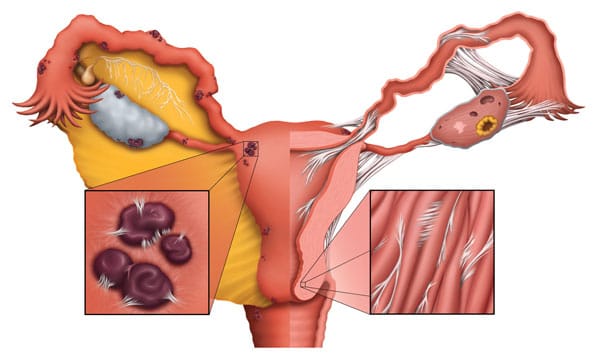
      At left, we can see adhesions at sites of endometriosis. At right, adhesions are shown on the inside of the uterus and fallopian tubes, decreasing fertility. At the bottom, adhesions within the muscle of the cervix can cause pain with deep intercourse.

      Symptoms and Conditions Caused by Pelvic Adhesions

      • Blocked fallopian tubes – One of the most common forms of infertility caused by adhesions is blocked fallopian tubes. Adhesions wrap around delicate structures inside the reproductive tract, preventing the reproductive system from working normally. Adhesions can restrict the flow of sperm through the fallopian tubes, preventing the fertilization of an egg. Most physicians no longer perform surgery on these delicate structures because post-surgical adhesions tend to block the tubes once again when the body heals from the surgery.
      • Hydrosalpinx – Another common tubal blockage is a hydrosalpinx. This occurs when fluid collects in the fallopian tube – generally as the result of an infection. As adhesions form at the end of the tube closest to the ovary, the tube swells, much as your knee might swell after a knee injury. Hydrosalpinx usually indicates a totally blocked tube; in the rare case that the end is open, the sperm still tend to get lost in a large amount of fluid in the tube, greatly decreasing the chance for conception and increasing the chance for an ectopic pregnancy, in which the fertilized egg becomes stuck in the tube.
      • Unexplained infertility – Adhesions don’t show up on most diagnostic tests. In order to verify that a patient has adhesions, an exploratory surgery is required to directly visualize the adhesions. Unfortunately, since most patients are unaware of adhesions, the question is never asked: “Maybe my infertility is caused by adhesions?” This can lead to many women suffering from unexplained infertility.
      • Prior surgery – Surgeries are sometimes necessary to save a woman’s life, as in the case of an appendectomy. There may be less urgency to perform surgery in the case of undiagnosed pain. In these cases, a doctor may suggest doing an exploratory surgery to directly visualize the pelvic contents. Because adhesions form after most pelvic surgeries, the very surgery to correct a problem can be the cause of adhesion formation as the body heals.
      • Chronic pain – Stuck, tight, immobile, constantly uncomfortable. These are all common descriptions we hear from patients suffering from adhesions. Because adhesions bind to structures and create constant tension, it is no wonder that so many patients with adhesions also suffer from chronic pain.
      • Sexual dysfunction – Some non-surgical treatments are available for women with intercourse pain (dyspareunia) or other sexual dysfunction. Studies on our work in this area have shown that women have an increase in every measurable criterion of their sexual health (desire, orgasm, lubrication, pain, and arousal) after being treated for adhesions.

      Treatments for Pelvic Adhesions

      Experience relief from debilitating pelvic adhesions with Clear Passage® Physical Therapy’s Free Consult and Request Info – discover how their unique, non-surgical Clear Passage® Approach has helped countless women overcome infertility, chronic pain, and sexual dysfunction caused by internal scarring, without the risks of additional surgery or medication. To learn more, visit our Apply to Therapy page.

      Few options exist for treating pelvic adhesions. Many treatments are aimed at treating the symptoms of adhesions, rather than the adhesions themselves. Following the Hippocratic Oath that all physicians should adhere to, we have always believed that a natural, non-surgical, and drug-free approach should be the first step in the treatment of adhesions. Below are the options we see that have passed scientific scrutiny and been found to be effective, listed from safest to most invasive:

      • Manual Physical Therapy – A non-surgical, all-natural treatment plan is what we consider the best treatment for adhesions. Clear Passage® has been researching and treating patients with adhesions for over 25 years. The Clear Passage® Approach (CPA) is a hands-on therapy that focuses on detaching and weakening adhesions inside the body. Helping patients have natural pregnancies, live a pain-free life, and avoid future surgeries is our number one goal.

      If you or a woman you know is suffering from the symptoms above, we encourage you to complete a contact form or call us at 1-352-336-1433. You will be able to schedule a phone consultation with a member of our patient support team at no cost, and learn whether our non-surgical and drug-free treatment is right for you.

      • Pain Medications – The rise in chronic pain conditions has been met with a rise in pain medication prescriptions. The opioid epidemic is a well-known phenomenon in America. Pain medication simply masks pain; they do nothing to address the cause of the pain. They do not provide permanent solutions; further, they can lead to severe digestive issues along with addiction and dependency. Pain medications should be considered a temporary palliative measure while the patient searches for an actual treatment.
      • Surgery – Lysis (destruction) of adhesions by cutting or burning them during surgery is one of the most common ways to combat adhesion growth. Many surgeons note that this isn’t a permanent solution and often leads to more surgeries, because surgery is the number one cause of adhesions. Surgery also has risks, such as the risk of anesthesia, complications, or infection, and “inadvertent enterotomy,” in which a surgeon mistakenly cuts into or through an organ s/he had not intended to, in the crowded and adherent structures of the pelvis.
    • Infertility Risk Factors

      Infertility Risk Factors

      Infertility is defined as the inability to achieve pregnancy after 12 or more months of sexual intercourse without the use of contraceptives. Infertility is a common condition that affects 1 in 8 couples each year in the United States. Many people don’t realize how common fertility issues are. This causes many people to be aware of the risk factors for infertility. Knowing and understanding the risk factors is a critical step in family planning. When individuals take a proactive approach and learn what issues they could face while trying to start a family, they have time to prepare and seek out professional help. Unfortunately, people often wait a year before seeking medical attention. Age is a crucial factor in reproductive health, and every year counts. This guide will help you understand the risk factors that could lead to infertility.

      Age

      Age is the biggest factor in a woman’s ability to get pregnant and have a healthy baby. A recent study showed that fertility tests can’t reliably predict the fertility of a woman later on in life. Starting at age 32, a woman’s fertility steadily decreases, and by age 40, her fertility has declined by half. A healthy woman at age 30 has a 20% chance each month of getting pregnant, while a woman who is 40 only has a 5% chance.

      When a woman ages, her egg quality also declines. Because of this, older women have higher risks of pregnancy complications such as gestational diabetes, placental abruption, and stillbirth. A woman who is over 35 years old is almost 2.5 times more likely to have a stillbirth than a younger woman. Once a woman reaches the age of 40, the chance of a miscarriage is greater than the chance of a live birth. Women who become pregnant at an older age should monitor their pregnancy, as they are more likely to have a child with birth defects or genetic abnormalities.

      Reproductive age is often measured by a woman’s levels of follicle-stimulating hormone (FSH). A high FSH (measured on days 2 to 5 of the period) indicates that the ovary is requesting higher levels of FSH, signaling the eventual end of a woman’s reproductive life. A non-surgical therapy to decrease FSH and increase pregnancies in older women has shown promising results.

      Body Fat

      Low Body Fat

      Studies have shown that women with a low body mass index (BMI) often struggle with infertility. Low BMI is the cause of 12% of all infertility cases. Body fat plays a very important role in a woman’s reproductive system. Sex hormones are stored in body fat, and without enough body fat, women can have a reduced amount of estrogen. Too little estrogen can cause amenorrhea, which is the lack of a menstrual cycle.

      High Body Fat

      A BMI between 25 and 29.9 is considered “overweight,” and a BMI over 30 is considered “obese.” Obesity can cause hormone imbalances that cause problems with ovulation. Obesity increases pregnancy complications and health issues for the baby. Risks associated with obesity are miscarriage, hypertension, pre-eclampsia, gestational diabetes, blood clots, required induction of labor, and stillbirth. Women who are overweight or obese have less of a chance of getting pregnant overall, and they are more likely to take over a year to become pregnant than women at a healthy weight. The risk of pre-eclampsia is 2 times higher in overweight women and 3 times higher in obese women. Overweight women are 2 times more likely to develop gestational diabetes, and obese women are 8 times more likely. A woman who is obese is more than 2 times as likely to have a miscarriage compared to a woman of a healthy weight.

      Sexually Transmitted Diseases (STDs)

      There are 12,000,000 new cases of STDs each year in the United States. STDs can often be asymptomatic, meaning they don’t produce any symptoms, and people are unaware they have contracted one. STDs can lead to pelvic inflammatory disease. Previous STDs can cause significant complications in a woman’s reproductive system. Some complications include scarring, miscarriage, adhesions, blocked fallopian tubes, and ectopic pregnancy (when a pregnancy occurs outside of the uterus).

      Diseased or Blocked Fallopian Tubes

      About 20% of all infertility cases are caused by fallopian tube disease. STDs are a major cause of tubal disease. Common causes of fallopian tube disease are gonorrhea, syphilis, and chlamydia. A hydrosalpinx occurs when a fallopian tube is blocked and filled with fluid. Pelvic inflammatory disease or other infections can often cause a hydrosalpinx.

      Because fallopian tubes often re-close after surgical repair, many reproductive physicians recommend removing the problem tube(s) and moving directly to in vitro fertilization (IVF). This procedure generally involves pharmaceutical treatment along with minimally invasive surgeries to extract, nurture, and then reintroduce the egg into the woman’s reproductive tract.

      A new non-surgical therapy, the Clear Passage® Approach, has been shown to open tubes naturally with a unique therapy designed to detach the adhesions blocking the tube. The therapy, which can feel like a deep massage, opened tubes in 69% of women who had never had surgery on their tubes, and 35% for those who had undergone prior tubal surgery.

      Adhesions

      Adhesions are internal scars (scar tissue) that can form throughout the body. Adhesions form after surgery, trauma, infection, inflammation, or radiation therapy. A woman with a past medical history including one or more of those events is likely to have adhesions. Adhesions affect the mechanical function of a woman’s reproductive system and are a major cause of blocked fallopian tubes, intercourse pain, and pelvic pain. Many people have adhesions without realizing it. We encourage you to read more about adhesions to find out if you are at risk for infertility.

      Endometriosis

      Endometriosis is a condition that causes uterine tissue to form outside of the uterus. The tissue can grow on the ovaries, fallopian tubes, bladder, or bowel. The connection between endometriosis and infertility is not clearly understood, but there are indications that adhesions forming at the site of endometrial implants can negatively impact a woman’s fertility. Symptoms of endometriosis include extremely painful menstrual cramps, heavy menstrual flow, diarrhea or painful bowel movements during your period, and painful sexual intercourse. Endometriosis appears to be passed down genetically, so if a woman has relatives with endometriosis, she is at risk.

      Overall Health Risk Factors

      • Chronic diseases, including diabetes, hypothyroidism, hyperthyroidism, arthritis, hypertension, and asthma
      • Hormonal imbalances or irregular periods
      • PCOS (polycystic ovarian syndrome). Read more about “What is PCOS”?
      • Multiple prior miscarriages
      • Environmental/dietary risks include smoking, alcohol, large amounts of caffeine, or an unhealthy diet

      Take Control of Your Fertility

      If you fall into one or more of these risk factor categories, now is the time to act. Too often, people take their fertility for granted, and only when they are trying to become pregnant do they find out they are infertile. Get a head start on your fertility. There are natural treatment options that can increase your chances of becoming pregnant before trying surgery, IVF, or fertility drugs.

      Talk to your doctor about any risk factors you have and how you can minimize their impact on your fertility or what you can do to prevent them. When it comes to infertility, always remember you are not alone, and you have options.

    • Adhesions in the Body: Presentation by Larry Wurn (Video)

      Adhesions in the Body: Presentation by Larry Wurn (Video)

      Larry Wurn, LMT, co-founder of Clear Passage®, presents an overview of 30 years of studying and treating adhesions. With images compiled from a presentation at a conference of physicians, the video provides an in-depth overview of the biomechanics of adhesion formation and the ways in which manual physical therapy can be an effective treatment. We thank endogyn.com for some of the remarkable images of adhesions they provided for this educational video.

      Unlock the secrets of treating adhesions with Clear Passage® Physical Therapy’s groundbreaking approach – Request Information and schedule your Free Consultation today to learn how our expert therapists can help you overcome pain and dysfunction, then visit our Apply to Therapy page to start your journey towards a life free from adhesion-related issues.

      Transcription

      I’m Dr Richard King, a board-certified obstetrician-gynecologist with 40 years of experience. I regularly perform surgeries two days a week during my professional career. In addition, I had the opportunity to conduct Clinical Research in Gynecology and other fields of medicine. I met Larry and Belinda W about 20 years ago. They told me they were having success treating blocked Fallopian tubes in their physical therapy practice using just their hands to clear adhesions and open the Fallopian tubes.

      Naturally, I was quite skeptical. But after reviewing several of the charts from their physical therapy clinic, I realized they were getting results that would be difficult to achieve in surgery, and I’m considered a very good surgeon. I have followed the Wurns and their treatment of adhesions with absolutely no remuneration for the last 20 years for two reasons.

      One, I’m fascinated with what they do and the results they achieve in several conditions normally treated with surgery or for which there is no effective medical treatment.

      Two, I believe this work is important to medicine as a conservative therapy that could eliminate many surgeries. Belinda and Larry have each treated roughly 40,000 patient hours over their career. They have published studies in scientific reports and in some of the most respected journals in the United States, including Fertility and Sterility, Gastroenterology, the Journal of Endometriosis, and WebMD’s Medscape General Medicine, edited by George Lundberg, the former editor of the Journal of the American Medical Association.

      I hope you’ll find this guided trip through three decades of their investigation of the manual treatment of adhesions to be as fascinating as I do. I give you a man I’m proud to call my friend and colleague, Larry Wurn.

      Hello, and thank you for that kind introduction. I am Larry Warren. My wife and I, physical therapists, have been treating adhesions and involved with adhesions for 30 years of our professional careers. Initially, we began treating adhesions and investigating them for very personal reasons through a nightmare we were undergoing; then, through hundreds, and finally thousands of patients, we started gathering data.

      Gathering physicians and biostatistical scientists to design and publish studies on whether or not we could actually treat adhesions non-surgically, manually using just our hands, the data is pretty compelling, we think. I’ll let you make your own decisions.

      The upside of this is that if adhesions can be broken apart non-surgically, and we’re not talking about just You can massage that and that’ll go away. No, that’s kind of far-fetched, but what is the actual structure of adhesions? What can we do, and what data do we actually have that have been published in peer-reviewed journals that show that adhesions can be broken down and decreased, perhaps eliminated non-surgically?

      The upside potential is huge for patients, for physicians, and for insurers. Certainly, patients don’t risk undergoing another surgery. Surgery is the normal treatment for adhesions when they get bad enough. A surgeon has to go in there and cut or burn adhesions; the problem is that no matter how brilliant and skilled the surgeon, the body creates new adhesions to heal from the surgery, so with each surgery, you develop more and more adhesions- at least many of these patients do, and there’s good data on this. Other risks include the cost certainty for insurers, which is a big deal for the surgeon, the surgical attendants, the anesthesiologists, and the renting of the surgical suite.

      Those of you who have read the latest data on the effects of anesthesia and multiple anesthetics on the brain know the risks there, and the information coming out is pretty compelling that there is a significant risk for a lot of patients with general anesthesia. The risk of inadvertent ostomy is when a surgeon goes in there, and he or she is looking around, trying to cut through adhesions, and some of these patients are so adhered that it’s really difficult to see what’s going on; you can inadvertently cut the bowel or intestines. A little bit leaks out, and suddenly you’ve got contents of the bowel in a warm, moist, dark environment; then you close that patient up, and three days later they’re in excruciating pain.

      They’re developing peritonitis; you have to open them back up in many cases, pour antibiotics in, and allow that patient to heal from the inside out, creating a huge scarring situation, of course, and adhesions.

      Being internal scars, that is the case where you’re actually intentionally cutting the belly to remove adhered, diseased, or necrotic tissue and reclosing the belly.

      We’ll look at that data. We’re not talking about a simple massage here; the idea that you could actually just go in and massage these is a little far-fetched, but we’re going to look more deeply at the structure of adhesions, how they are composed, and, um, how this can work so you can make your own determinations.

      At the end of this, we will go through the 30 years pretty quickly, now looking at where we started with the structure of adhesions, what data we have found, and where we’re going next.

      In 1984, my dear wife went to a physical therapist from the University of Florida and developed massive adhesions after 72 hours of internal radiation therapy and 40 external radiation treatments. They put her in a lead-lined room with radioactive pellets inserted inside of her and said You know it’s dangerous for any of us to be in this room for more than about five minutes, but don’t worry; we’ll keep you drugged. We really need to get rid of this tumor.

      A year after that experience, she began having debilitating pain whenever she walked, moved, or breathed. She was in excruciating pain.

      I saw my beautiful and brilliant wife just deteriorating before my eyes. We talked to our doctors about it. They said, “Well, you cured our cancer, you know, but you really don’t want us to operate there. I mean, this vaginal tissue and pelvic tissue is so delicate; we’re just going to create more adhesion; she’ll just have to learn to live with it.”

      We were not interested in following that prognosis. We know that she had a frozen pelvis where everything was stuck together; all of the organs in her pelvis were just adhered together and stuck like in a massive straitjacket.

      We could not accept the diagnosis that you’re just going to have to learn to live with the pain. We began to investigate our own ways that we could perhaps decrease adhesions without surgery. We learned that adhesions form naturally in the body whenever and wherever the body heals. They rush in to surround the area that’s been injured; once they form, if they don’t dissipate within 7 to 10 days.

      They’re with you for life. The problem is that adhesions are made of collagen, and collagen covers virtually every structural cell in the body, so the body has no way to dissolve or detach adhesions on its own. Once they are formed, they stay there; they either stay the same or they get worse over the course of life.

      This is probably what my wife’s body looked like a year after her radiation therapy, where everything was stuck together, the adhesions forming ropey structures that glue or squeeze structures that should be able to move freely. It causes dysfunction; infertility can stop literally organ function, and can cause a tremendous amount of pain, gram for gram.

      We know that adhesions are actually stronger than steel. They’ve been estimated at roughly 2,000 lb per square inch, so you can lift a horse with a square inch of them. When they attach to structures, they can cause significant pain, and the surgical answer up till now has always been, well, let’s cut those out, let’s burn them. Certainly, you can cut or burn the ones that you can see; you can’t cut or burn the ones that are inside an organ without cutting into that organ, causing more damage, even when you just cut or burn the external adhesions.

      The data shows that after surgery, and this was a study from several hundred thousand patients- a 50-year study showed that 55 to 100% of pelvic surgeries and 90% of abdominal surgeries cause adhesions to form from digestive surgery, and you have the reference there; you can pull it off our website if you like

      Looking a little deeper, here are some adhesions as they form. They’re like tiny strands of collagen, here depicted in a muscle forming from cell to cell within a muscle. You can imagine that it’s virtually impossible for a surgeon to get to those without injuring the muscle. Looking even closer, we discover that these tiny strands themselves attach to each other and to the underlying structure with a molecular chemical bond.

      That bond we found is susceptible to being disrupted or detached by using sustained pressure and some other techniques that we use; certainly, we have to be very site-specific and understand the anatomy very well.

      Understand where we are in the body and be able to understand what’s adhered, but given that we find that we can be very successful with many of these patients, it takes a bit of time; as those bonds dissolve, that strand detaches, and sure, it’s probably still attached at the other side, but there’s already collagen covering every cell on the body.

      The important thing is that it detaches from the next one and the next one and the next one, so it becomes like pulling out a run in a sweater in a three-dimensional sweater in very slow motion for us. Looking at other depictions, we started after we treated my wife; we started treating other patients who came to us with pain, and we were initially surprised when women with block Fallopian tubes started reporting they were becoming pregnant and their tubes were opening.

      It was very easy to check that because there’s an HSG dye test that is inserted into the uterus, where we radiographically view that you can see it has not come out of this particular tube. There’s a hydrosalpinx contributing to the swelling in that tube as well. After therapy has come through one of the tubes, there is still a hydrosalpinx in that particular tube.

      But this is just one of them when we talk about hydrosalpinx. If you like, we wrote to the gynecologist in town, and we said, you know, we’re seeing results in opening blocked Fallopian tubes. The chief of staff of the hospital, Richard King, whom you just met, called us in as a research gynecologist and surgeon with 30 years’ experience. At that time, he said, “What’s this about opening blocked fallopian tubes?”

      We handed him half a dozen charts, and he looked at them and said, “Gosh, you’re doing things with your hands I’m not sure I could do them surgically!” I said, “Well, is that okay?” and he said, “Well, yeah, it’s actually really great!” It’s neat that you have done any research; no, would you like to be sure? Let’s research this.

      I’ll join you if you like. You need to have somebody who understands research, and I’ll just chip in my time. I’m pretty fascinated.

      So we began doing research on our patients and presented at the American Society of Reproductive Medicine, a meeting of about 9,000 physicians. We did a couple of posters and an oral presentation on decreasing adhesions for hydrosalpinx; in this particular poster, improving some other functions in women with endometriosis, and followed up with a study we published, which is now available at the US National Library of Medicine PubMed and Alternative Therapies in Health and Medicine on opening blocked Fallopian tubes.

      At the time we we just had a very small I think there were 28 patients in this study- and our success rate for opening blocked tubes was 61%, still pretty good, we thought, after just manual therapy. Just using our hands pulled these adhesions apart, but it was a small number. As a matter of fact, in 2015 we published a 10-year study, a retrospective of nearly 1,400 women. Interestingly, in this case we had 235 women with totally blocked fallopian tubes, either both tubes blocked or one removed and the other blocked, so we had half the chance to open tubes; we had a 61% success rate.

      The same success rate here: you can see the comparison of the therapy in blue versus surgery in green interesting sub-note is that the patients who had not undergone tubal surgery prior to our therapy had a 69% success rate for opening tubes; those who had undergone a prior surgery had a 35% success rate. So again, it’s the adhesions that form after surgery that are the problem. For physicians and patients, functionally, our success rates were quite a bit higher than the studies we could find for surgery, where our pregnancy rate was 57%.

      About double what the surgical success rates were for pregnancies after surgery. As an aside, we’ve seen success with other hormone-based conditions.

      We were surprised when FSH levels plummeted in many patients, and we saw that 39% became pregnant even though their FSH was 10 or above, indicating subfertile or infertile conditions when we treated women prior to their IVF transfer. 56% became pregnant with their next IVF, much higher than the national success rate.

      Interestingly, some of our highest successes were in women over 40 the success rates were close to three to five times the pregnancy rates of IVF without a pre-transfer therapy some women started calling us and saying, “Gosh I’m having some unusual side effects anybody ever reported that to you and what are you talking about he said well well it’s a little embarrassing but I’m having orgasms like I’ve never had before and my wife said to them is that okay yeah it’s great actually but it’s just so remarkable that I wanted to report it to you.”

      We started getting more and more reports like this, and we started talking, and we mentioned it to Dr King. He said, “That’s really important”. We said, “Yes, it is he said there’s nothing really in medicine that increases orgasm, and we can measure those responses what do you think we’re doing we said, “Well, we’re doing nothing but what we always do, and we’re treating adhesions, so sometimes they adhere to the cervix and it feels fibrous just to no stiff and we’ll be working on that.

      So the husbands are running into that, then they’re having pain with deep penetration; otherwise, on the vaginal walls, we’re working on the vaginal walls. Maybe those adhesions there are forming from bacterial infections, vaginal infections, or rough sex, or just adhesions there are masking the nerve, decreasing desire or lubrication, and orgasm. I know those particular domains because we could actually measure those domains of sexual function in our patients.

      We did publish a study in Medscape General Medicine, the largest medical journal in the world owned by WebMD, which is the one that George Lenberg edited after editing the JAMA for 17 years, that showed the increases in sexual function and decreases in intercourse pain were very high, and a decrease in improvements in the other domains of sexual function is shown here.

      Desire, arousal, orgasm, lubrication, and so forth, women started coming to us saying, “Gosh, you know I’ve been doubled over for two days every month with endometriosis pain since you treated me. My period came; I never even knew it was coming; it totally surprised me.”

      That was shocking to them, and we really didn’t know that much about endometriosis at the time. Of course, we were just treating adhesions. What could we be doing with these women? Well, we found that adhesions form wherever endometrial tissue lands on the body. It’s frequently and often that we find adhesions forming. We believe that what happens is that we’re not really treating the endometriosis.

      We’re just treating the adhesions that, as those tissues swell every month with a woman’s period, it’s pulling on those adhesions, creating a pull on the underlying structures, creating pain in the underlying structures, and as we break those adhesions or detach them.

      The decrease in pain is significant. The only other thing that these women could do is either go on birth control pills if they didn’t want to have a child, so the tissue wouldn’t swell, or have surgery.

      So this presented a nice alternative for people who did not want to have their IND endometrial implants burned off and didn’t want to undergo surgery. We published in the Journal of Endometriosis, and the founder of the Endometriosis Association joined our Board of Advisors. She was very impressed and started noticing that the study showed the improvements in endometriosis pain just from therapy alone lasted for over 12 months, which is as long as surgery has ever been shown to last.

      As far as function, again in our recently published study or 2015 study, success rates for pregnancy for women who were infertile due to endometriosis were about equal to surgery, so that’s from 299 women who have progressed, and meanwhile, my wife is by this time. She’s working full-time; she’s doing great; she has no pain; she’s gungho and really pretty fascinated.

      We started realizing that there was another problem for a lot of our patients, and that is people started calling us and saying I’m having bowel obstructions; I’m going back and back to the hospital for another and another surgery. I’m in the hospital with an NG tube in my nose and IVs in my arms. They’re cutting me open, and the worst part is I don’t know when I’m going to have to go back.

      Adhesions form in the bowel as they did with Belinda we saw in some of those early slides just as they form anywhere in the body they can form on the outer Loops of the bowel squeezing it like a garden hose they can form inside the bowel as they do in Fallopian tubes bowel adhesions can be massive and this is an image of some adhesions that you can see so you can see that it’s it can be a huge problem when structures like this form in delicate tissues that are supposed to be helping your food move through 21 ft of your small intestines down to your large intestine.

      What do physicians do when the bowels become obstructed? Well, the cost of bowel adhesiolysis surgery, that is, the surgery to decrease adhesions itself, is high.

      From 2010, the Department of Health and Human Services and the patients who just went in for adhesion surgery averaged a little over 8 days in the hospital, and about one out of eight of them were re-admitted to the hospital within 30 days, probably from some of these. Often, from some of these complications I mentioned earlier in the bowel, it can be really serious, as strictures of narrowing or total obstructions prevent food from going through the bowel- a life-threatening condition.

      The average cost to insurers and to the US population is over $100,000 a piece, and there were over 100,000 of them performed in 2010. The cost and quality of life are much higher.

      So here you have an ordinary American citizen who suddenly can’t take food in and feels nauseous. There’s a tremendous pain when nothing’s coming out. They go to the hospital. In the hospital, we do put an IV in them with some fluids or dilute something to help numb things and give them help to slow down.

      It will actually stop mobility together, but then, when we’re going to give them liquid and IV nutrition, put an NG tube through their nose and into their stomach to pump out the contents of their stomach so that we don’t build up pressure there, and now we’re just going to wait. And we’re going to see, Sir or Madam, if this clears well.

      What happens if it doesn’t clear well? If it doesn’t clear, we’re going to we generally will cut you. We always cut you open. We’ll pull out usually all 21 ft and examine that bowel. Wherever it’s bad, we will cut.

      What’s bad, we will throw it away, sew back what’s still okay, and put it back into you, and that’s what we’re looking at while you’re lying here. Okay, we can do a CAT scan to see if we can find out exactly where it is. Hopefully, we can do this laparoscopically, but it is a major surgery, so the average wait in the hospital is over 2 weeks. About one out of five is readmitted to the hospital within 30 days of their surgery due to some of the complications I talked about earlier.

      35% are readmitted, have another surgery, and within 10 years of their life, 2/3 of those are within the first year. This is from The Lancet, a highly respected Journal, as you all know, from 30,000 patients, and you see the data there just as I have extrapolated it.

      The huge problem in medicine is that brilliant surgeons want to help their patients, but in the end, after the surgery, they can look at their patients and say, “Here’s my card. The chances are reasonable that you’re going to be back.

      This is going to happen again for our patients. They tell us, “You know, it used to be that every day I’d look in the mirror and say What do I want to do today? What do I have to do now? I look at the mirror every morning, and I say, “Is this the day I’m going to die? Is this the day I’m going to be put into the hospital and maybe cut open? I’m afraid to go on a trip with my spouse. I’m afraid to go to my sister’s house. I don’t know what I can eat. I’m afraid something’s going to clog it up because I know I’ve been compromised, and I know that those adhesions are going to come back.” My doctor told me, “Well, they’re pretty likely to come back, and they do.”

      A big problem in medicine is an expensive problem, and one of the problems of huge human [Music] suffering surgery is the primary cause of bowel obstruction, so it’s brilliant, and it’s wonderful, and as dedicated as your surgeon is, he or she cannot prevent adhesions from forming, and the films that they’ve used, the tissues, and different things to prevent adhesions.

      None of them has skewed these numbers significantly at all. What are we looking at? Remember, we’re still looking at tiny little strands. Yeah, the surgeon may see ropes or curtains or balls of adhesions, but at its very core, these adhesions are made of tiny strands attached to each other with a small molecular bond.

      What a concept to be able to go in there and, like the run in the three-dimensional sweater, pull those apart so that those little attachments that are susceptible to a sustained stretch begin to dissolve. It’s like pulling out the run in a sweater and without surgery, without the risk of ostomy, without anesthesia, and for a fraction of the cost.

      What a neat concept. Once we realized we could open and clear blocked fallopian tubes, we started to look at adhesions in the bowel. This life-threatening condition we’ve been talking about was one of our early patients; actually, our first patient for bowel obstructions had undergone six bowel obstruction surgeries. She called us up; she said, “Yes, my last surgery was 12 weeks ago, and they’re scheduling my seventh surgery now.

      For those of you who are surgeons out there, you just know how serious and dramatic that surgery is. I’ve lost 18 pounds. I can only ingest liquids; it’s getting worse and worse. You’ve got to help me. They’re trying to help, but they’re killing me.

      She came in, and we treated her. We had by this time developed a 5-day program where patients start on Monday, and they’re done on Friday afternoon, four hours of therapy a day. By Wednesday afternoon, Wednesday evening, Belinda and I took her out to dinner. We had fish and some soft-cooked vegetables. She was able to cancel her surgery; she has started eating again. She can eat pretty much whatever she likes now, and it’s been nearly 8 years now, and she’s not had another surgery on her bowel since.

      Then we began doing more serious research before and after radiologic testing. In one case, we have a radiologic report showing obstruction before therapy, totally cleared of obstruction after therapy, and strictures, which are the tightening of the course of the bowel. In this case, the intestines before therapy and after therapy had no stricture at all, so we began to get excited about the science we were developing. We hired a woman with two PhDs. An expert in disease modeling, familiar with working at very small levels inside the body and at the chemical and molecular level, to help us determine what we were doing and to help us publish studies.

      Those radiologic reports are available in the Journal of Clinical Medicine, published in Healthcare. We created a validated study to look at quality of life differences because, for us as a physical therapy group, quality of life is very important. It’s not just “Do you have pain?” or “Do you not have pain?” “Can you eat?” or “You’re going to die.”

      Yeah, those are very important, but what’s your quality of life? Like, what can you actually do when you look in the mirror? Do you feel like I’ve got a life, or is my life basically over? I’ll never have my life back again.

      Using that, the validated scale was published. In healthcare, we created and published some of the first of our pilot cases, presented to 15,000 gastroenterologists at Digestive Disease Week in Washington, DC, in 2015. Published the pilot study in Gastroenterology as an investigation of treating bowel obstructions.

      Non-surgically, as part of that poster presentation, we found that we improved and had a really tight p-value of 025. We had significant improvements in pain, quality of life, and range of motion because, when you think about it, as you get adhered, it pulls you forward. For so many of these people, they’ve had their iliac valve cut out; you’re getting pulled forward. Right now, you can’t stand up; you can’t bend. You certainly can’t bend backward nearly as well, so we started measuring range of motion as a measure of how well we were doing, as well as pain.

      We did not do as well on diet and medication because we were a little bit skewed by the numbers. Only about half of the patients that we treated had restricted diets or were on medications, so although they showed significant improvements when we threw them in with the ones that had no problems beforehand and no problems afterward. It threw the P values off a bit. Looking a little bit deeper at the poster that we presented, the dark blue at the bottom represents normal, so you can see the changes from the diet pain.

      Gastrointestinal symptoms, quality of life, and medication from before on the left and after therapy on the right. For those of you who prefer numerical graphs, you can see a consistent return to normal in those areas, where the range of motion changes with P values that were pretty much off the chart as far as improvements in all ranges of motion.

      When I asked our PhD, “What do you think the mechanism is? What exactly are we doing here?” These are the areas that she suggested where we were showing improvements, as scientists and all clinicians who are conducting clinical research. Measure the side effects and adverse events.

      We did find that the adverse events, the major ones, are shown at the bottom, but they were transient. They were temporary, and they tended to go away within a few days. We do screen our patients for contraindications to therapy because we’re treating in an interstitial area, and we want to make sure that people do not have infections.

      Sometimes we’ll ask for blood for CDCs with CBCS with different SHS so that we can see if there’s a skewing of the neutrophils. Certainly, we don’t treat anyone who’s had surgery in an area that we’re going to treat within the last 30 or 90 days. We began creating a Home maintenance program because we saw that in the beginning, when we treated one woman, she was having the typical one. She was having bowel obstructions like clockwork every 3 weeks, and after we treated her, we thought she figured she was good to go.

      We opened her tubes before we cleared her bowel obstruction, and instead of having them every 3 weeks, she went 19 months, but then she had another obstruction, and we had two or three of these that showed us two things: one, we were making really dramatic improvements too. It wasn’t just that their guts and their intestines had been compromised, really for life, by their surgery.

      These people have bowel obstructions, so we’ve begun an educational program with each of our patients where we teach them about the structure of adhesions, how they form, how they deform, how they can deform themselves, how they can maintain, and perhaps even increase the results.

      When we get the need for repeat surgeries, it is a huge concern for patients. Having been handed this card, you’ll probably be back, or you may be back. We do know that within a short period of time, 30% of patients will return to the hospital for a repeat surgery; this is from the literature. Before we created our maintenance program, we had a 7% return to the hospital. Since we created and instituted this Home Maintenance program with all of our small bowel obstruction patients, our return to the hospital is 3%, not zero, but better than 30%.

      We’re now conducting a larger Phase 2 study on small bowel obstruction with 350 patients. We’ve also recently started working with Physicians who treat SIBO, which is small intestinal bacterial overgrowth. When the bacteria that normally reside in the large intestine migrate up into the small intestine, it can be inconvenient; those bacteria can actually start eating away at the nutrition. So, we’ve had patients who have lost a tremendous amount of weight, like 80 to 85 pounds, or who have had these bacteria actually eating on the inside of their intestines.

      When Physicians treat them with antibiotics, the antibiotics can really help decrease those bacteria. The problem is that if there are adhesions in the gut, those bacteria will come back, and they don’t escape. They can’t get out, so we started working with a lot of SIBO Physicians to coordinate care with their patients so the patients get antibiotic treatment, whether it’s natural antibiotics or pharmaceutical, and we treat, and they may be back and get a little bit more antibiotic treatment.

      We are the mechanics in the process; we help clear the adhesion so the intestinal bacteria that get blocked up in the intestines can escape, so that’s pretty much it. That’s where we are after 30 years of this investigation. The question in the beginning was, “Can adhesions be treated non-surgically?

      I’ll let you make your own determination; keep in mind that in all of these conditions, all we’ve been doing is treating adhesions. That’s what we know how to do, whether it’s blocked fallopian tubes, infertility, sexual dysfunction, chronic pain, adhesive pain, bowel obstruction, or small intestinal bacterial overgrowth. The common factor for us, and the one that we have used in all of our published data, is treating adhesions with our hands, so to that question to us apparently, the answer is yes.