In February 2025, the administration took significant steps to address fertility treatment accessibility in the United States. The executive order aims to make in vitro fertilization more affordable and accessible to Americans struggling with infertility. This comprehensive article explores the details of this policy change and what it means for those considering fertility treatments.
Possible Grants for In Vitro Fertilization: May Open New Funding Opportunities
The recent policy shift may open up new avenues for couples seeking financial assistance for fertility treatments. Various grants for in vitro fertilization may be available through both federal programs and private organizations. These funding sources can significantly reduce the financial burden that often prevents couples from pursuing their dreams of parenthood.
With the latest executive order, the administration may potentially allocate substantial IVF grant money to support couples undergoing fertility treatments. President Trump, ‘The Fertilization President’, has made it clear that expanding access to reproductive technologies is a priority, with the executive order directing agencies to identify ways to reduce costs and increase affordability. These grants typically cover partial or sometimes complete costs of IVF cycles, medication, and related procedures. Although no funding is available yet, this is our hope.
Organizations like the Baby Quest Foundation, The Cade Foundation, and Fertility Within Reach now offer competitive grants ranging from $2,000 to $16,000 to qualified applicants. Additionally, several state-mandated insurance coverage programs have expanded, requiring insurers in participating states to cover more fertility treatment costs than before.
What Was in the IVF Bill?
The executive order signed on February 15, 2025, focused on ensuring reliable access to IVF treatments across the country. While not a bill passed by Congress, this executive action directs federal agencies to take specific steps toward making fertility treatments more accessible and affordable.
Key components of the IVF executive order include:
Directing the Domestic Policy Council to develop recommendations to “aggressively” reduce costs associated with IVF treatments
Instructing health agencies to identify and ease “unnecessary statutory or regulatory burdens” that limit access to fertility treatments
Exploring options for expanded insurance coverage of fertility procedures
Creating a framework for standardizing costs across treatment centers nationwide
The order reflects the administration’s stated policy to “ensure reliable access to IVF treatment” and make it “drastically more affordable” for Americans struggling with infertility. While the executive order itself doesn’t directly change any policies, it sets in motion a process to address the high costs that often make IVF inaccessible to many Americans.
It’s worth noting that this executive action comes in the context of ongoing debates around reproductive rights, with the administration positioning itself as supportive of fertility treatments while navigating complex political terrain regarding fetal personhood and reproductive medicine.
IVF Pregnancy: Understanding the Journey
For many couples facing fertility challenges, IVF represents a beacon of hope. However, understanding the process, its costs, and potential alternatives is crucial for making informed decisions.
IVF Process
The IVF process involves combining eggs and sperm outside the body in a laboratory setting. Once fertilization occurs and embryos develop, one or more embryos are transferred to the woman’s uterus with the hope of implantation and pregnancy.
This medical intervention bypasses many common fertility barriers, including blocked fallopian tubes, male factor infertility, endometriosis, unexplained infertility, and genetic disorders. The procedure has helped millions of couples worldwide achieve pregnancy when other methods have failed.
IVF Process Step by Step
Ovarian Stimulation: Fertility medications stimulate the ovaries to produce multiple eggs instead of the single egg that normally develops each month.
Egg Retrieval: Once the eggs have matured, they’re retrieved through a minor surgical procedure using ultrasound guidance and a hollow needle.
Fertilization: Retrieved eggs are combined with sperm in a laboratory dish to facilitate fertilization. In some cases, a single sperm may be directly injected into an egg (a process called ICSI).
Embryo Development: Fertilized eggs develop into embryos in the laboratory over the next 3-5 days.
Embryo Transfer: One or more embryos are transferred into the woman’s uterus using a thin catheter.
Pregnancy Test: About two weeks after the embryo transfer, a blood test determines if pregnancy has been achieved.
Pre-IVF treatment with Clear Passage® targets underlying structural issues that might interfere with successful embryo implantation. Their manual physical therapy approach addresses adhesions and scarring in the reproductive tract that conventional medical treatments might miss. This non-surgical approach has been shown to improve IVF success rates by as much as 50% in studies.
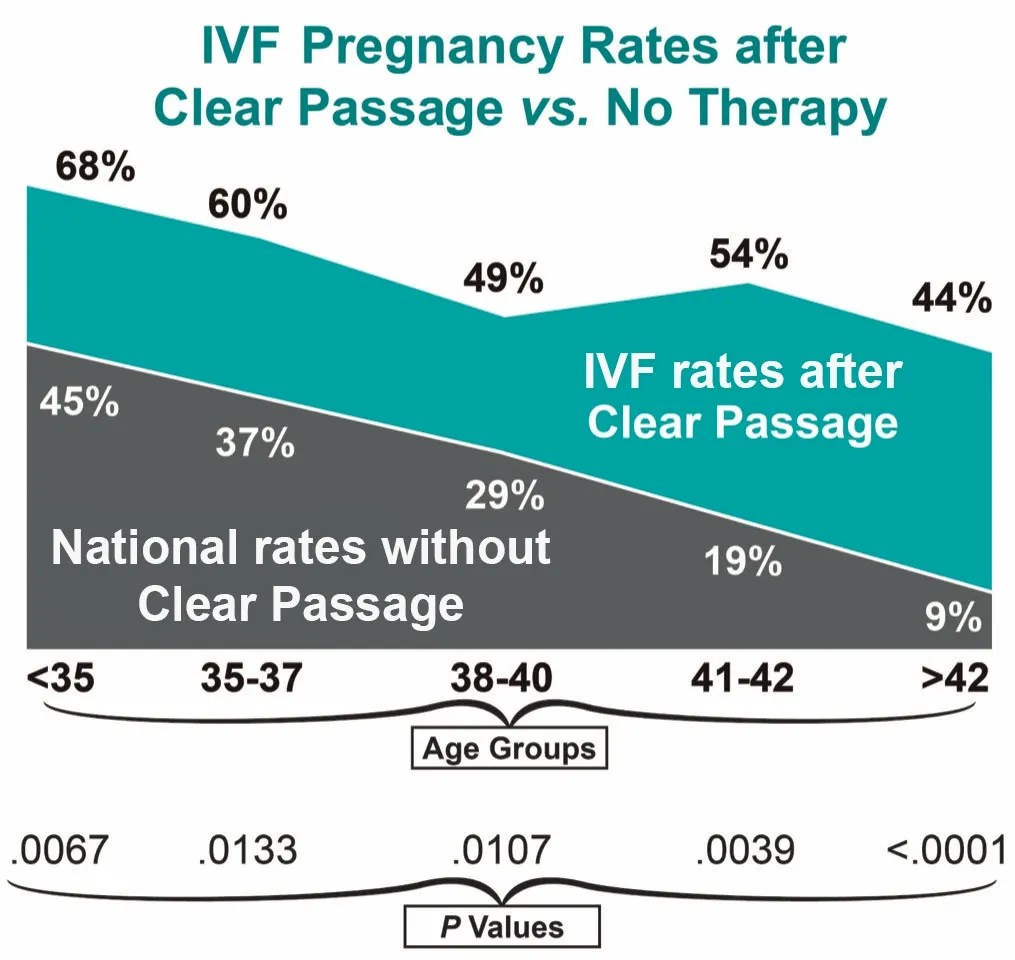
Compared to the US national post-transfer success rate (shown in gray), CP therapy (in teal) significantly increased IVF pregnancy rates in every age group when performed before embryo transfer. Rates among women over 40 were three to five times the national average.
For women who have experienced failed IVF cycles, the financial implications can be devastating, with costs potentially exceeding $50,000 for multiple attempts. Clear Passage® therapy, when used before IVF, may help avoid these repeated expenses by addressing underlying issues that could contribute to IVF failure.
Alternatives to IVF: The Clear Passage® Approach
When exploring fertility options, it’s important to consider that traditional IVF might not be the optimal first choice for everyone. Clear Passage® therapy offers a non-surgical alternative that addresses many underlying causes of infertility, particularly those related to structural issues, at a fraction of the cost of traditional IVF.
The Clear Passage® approach focuses on manually breaking down adhesions (internal scars) that can form in the reproductive organs. These adhesions can restrict mobility and function in the uterus, cervix, and fallopian tubes, creating barriers to natural conception. By gently manipulating tissues, Clear Passage® therapists can restore normal movement and function, potentially improving fertility without the need for medication or surgical intervention.
The financial aspect of fertility treatments cannot be overlooked. A single IVF cycle could cost anywhere from $12,000 to $25,000, including medications, procedures, and monitoring. Many couples require multiple cycles, potentially increasing the total cost to $50,000 or more.
By contrast, the average cost of infertility treatment with Clear Passage® is approximately $7,500. This one-time therapy may be sufficient to address underlying issues and restore fertility naturally. For more detailed information about program costs, visit Clear Passage®’s pricing page.
“IVF can cost $12,000 to $25,000 and can reach as much as $50,000 with multiple attempts, while Clear Passage®’s average cost of therapy is $7,500.”
– Clear Passage®
Even for couples who ultimately pursue IVF, Clear Passage® therapy beforehand can improve success rates, potentially reducing the need for multiple expensive IVF cycles.
IVF Process vs. Clear Passage®
While IVF works by bypassing reproductive tract problems, Clear Passage® therapy aims to fix these issues. The IVF process involves hormone injections, egg retrieval, laboratory fertilization, and embryo transfer—all medical procedures with associated risks and side effects.
Clear Passage® therapy, on the other hand, is a drug-free, surgery-free approach that uses specialized manual techniques to address physical barriers to conception. There are NO embryos created or destroyed in this therapy. This therapy typically involves:
A thorough physical assessment of structural issues
Customized hands-on treatment to release adhesions and restore mobility
Follow-up care to ensure lasting results
Many patients report not just improved fertility, but also reduced pain and better overall pelvic health after Clear Passage® therapy. For women who want to avoid the hormonal and physical impacts of IVF, Clear Passage® offers a more natural approach.
Why is IVF Morally Wrong?
Some individuals and groups raise moral objections to IVF, citing concerns about the creation and potential destruction of embryos outside the natural reproductive process. Religious communities, including some Anabaptist groups, Catholics, and Fundamentalists, may find traditional IVF problematic due to beliefs about the sanctity of life beginning at conception.
For those with such ethical concerns, Clear Passage® offers an alternative that works with the body’s natural processes rather than replacing them. The therapy has been sought out by members of conservative religious communities, who desire children but want to avoid treatments that might conflict with their moral or religious beliefs.
Moral objections to IVF often focus on the manipulation of human life, the potential destruction of embryos, and the separation of procreation from the marital act. Others express concerns about the ethical implications of genetic selection and the potential for treating children as commodities. Clear Passage® therapy sidesteps these ethical dilemmas by working to restore natural fertility rather than replacing it with laboratory procedures.
What Conditions Would Clear Passage® Be Better Than IVF
Clear Passage® Physical Therapy might be a better first-line treatment than IVF for several specific conditions:
Blocked Fallopian Tubes: Clear Passage® therapy has a documented history of success in opening blocked tubes, including cases of hydrosalpinx (swollen tubes). By addressing the actual blockage rather than bypassing it with IVF, patients may achieve natural conception.
Endometriosis: The therapy can help release adhesions associated with endometriosis, improving fertility and reducing pain. For women with endometriosis-related infertility, Clear Passage® may resolve the underlying issue rather than working around it.
PCOS (Polycystic Ovarian Syndrome): Women with PCOS who struggle with ovulation have seen improved pregnancy rates with Clear Passage® therapy, even in cases where conventional treatments have failed.
High FSH (Follicle-Stimulating Hormone) Levels: Some women with elevated FSH levels, indicating declining ovarian function, have experienced improved fertility with Clear Passage® therapy, even when reproductive endocrinologists considered them poor candidates for IVF.
Adhesions: Clear Passage® directly addresses the adhesions that can restrict movement and function in the pelvic area, potentially improving overall reproductive function.
Blocked fallopian tubes are a common cause of female infertility, preventing the egg and sperm from meeting. While surgical interventions exist, they carry risks of creating new adhesions and scarring. Blockages can result from various factors, including pelvic inflammatory disease (PID), endometriosis, hydrosalpinx, previous surgeries, and other medical conditions.
Clear Passage® therapy offers a non-surgical approach to opening blocked tubes by targeting the adhesions that cause the blockage. This therapy has shown success in opening completely blocked tubes and restoring natural fertility, potentially eliminating the need for either surgery or IVF.
Endometriosis can significantly impact fertility by causing scarring, inflammation, and altered egg quality. Surgical treatment of endometriosis, while sometimes necessary, can create additional adhesions that further complicate fertility.
Clear Passage® therapy targets and breaks down the adhesions that often accompany endometriosis, potentially improving fertility without creating new scar tissue. For women with endometriosis who wish to conceive, this non-surgical approach may provide relief from symptoms while simultaneously improving reproductive function.
Polycystic Ovary Syndrome (PCOS) is a common cause of infertility because it interferes with ovulation. This hormonal imbalance can lead to irregular or absent periods, making conception difficult. While PCOS is primarily a hormonal condition, Clear Passage® therapy can help address secondary issues that may contribute to infertility, including adhesions that might affect reproductive organ function. For women with PCOS, Clear Passage® therapy can complement other treatments to improve overall fertility, potentially avoiding the need for more invasive procedures like ovarian drilling or immediate progression to IVF.
15 failed IUIs, 7 failed IVFs, 2 children after Clear Passage®
“I feel 100% better than I did before your therapy. Anyone who has gone through extensive fertility treatments can appreciate the wonderful environment you provide at Clear Passage®. After going through your program, I don’t know how anyone can go through fertility treatments without first getting their body as close to 100% as possible.” – Hailey
Clear Passage® is a world leader with over two decades of experience improving female fertility, including treatment before IVF embryo transfer. As early as 2004, a study in WebMD’s Medscape General Medicine indicated that our manual therapy increased IVF results. Some of our highest pregnancy rates were in women between 35 and 45 years of age who had experienced several prior failed IVF cycles.
Our work addresses the physical quality, mobility, and motility of your reproductive organs in ways your reproductive physician cannot do. The results of our focus on helping these organs are clearly shown in the video below.
Compared to the US national post-transfer success rate (shown in gray), CP therapy (in teal) significantly increased IVF pregnancy rates in every age group when performed before embryo transfer. Rates among women over 40 were three to five times the national average.
In 2015, we collected data on these success rates and published results in a 10-year study of 1392 infertile women. (Rice et al., 2015a) The results of that study were eye-openers. IVF pregnancy rates averaged 56% across all age groups. Among other surprises, women over 42 were nearly five times as likely to become pregnant with IVF if they received Clear Passage® therapy before embryo transfer (p<.0001). You can read exact statistics grouped by age below, or at our Success Rates page.
Please complete a Medical History Form so we can review your case and advise whether we feel we can help you.
Pre-IVF Therapy Overview
In vitro fertilization (IVF) is a remarkable and complex process in which sperm and egg are united outside the body and transferred into a woman’s reproductive tract. While success rates of IVF have steadily increased since the first successful transfer in 1978, IVF success rates remain around 31% as reported by the U.S. Centers for Disease Control (CDC). You can view a chart that compares CP therapy (alone and with IVF) to IVF rates alone on this page.
Our earliest Infertility studies with pre-IVF data included 25 women and were published in 2004. (Wurn et al., 2004a) By the time the early pilot study closed, 60% (15/25) of the women had conceived or were still pregnant.
In a larger, landmark 10-year study of over 1,000 infertile women treated at Clear Passage® for various types of infertility, the overall IVF pregnancy rate was 56.16% (82/146) (Rice et al., 2015a) for women who had Clear Passage® therapy before IVF transfer. Calculated across all age groups, this rate is much higher than the rate for IVF alone.
IVF physicians may stimulate the ovaries with medications to increase egg production. After extraction, the eggs are united with sperm and placed inside the reproductive tract.
Treatment
Clear Passage® Treatment
Our manual therapy appears to assist IVF transfer in several ways — some documented, some assumed.
Increased blood flow to the ovaries, uterus, and possibly the pituitary
Improved implantation by decreasing microadhesions on and within the uterine wall
One focus of Clear Passage®️ therapy is to decrease tiny adhesive cross-links at the cervix and uterus – to decrease spasm and create a more hospitable surface for implantation.
As we go through life, all people develop adhesions (internal scars) as our bodies heal from life events. The female reproductive tract is subject to infection, inflammation, trauma, and surgery. When bacteria or items enter the vagina from the outside world, the delicate internal tissues can be subjected to microtrauma. These generate adhesions as the body begins to heal. Many women have a contributing history of infection (bladder, yeast, vaginal, etc.) or more serious trauma (falls onto buttocks, accidents, abuse). The body lays down collagen fibers – the building blocks of adhesions, as the first step in healing from any of these events. After the body has healed, the collagen fibers remain, binding tissues that should move freely. Clear Passage® therapists are experts at deforming and detaching these fibers, returning the body to an earlier state of mobility and function. In doing this, it returns fertility to many women.
The decision to undergo IVF is a serious one. You may find it educational to watch the video below of a patient who compares undergoing treatment at Clear Passage® to her experience undergoing In Vitro fertilization.
In summary, our site-specific hands-on therapy appears to decrease spasm and mechanical factors (such as adhesions) at the uterus, cervix, and fallopian tubes. Statistical data show that the therapy increases implantation rates and improves FSH levels. A full 39% of women with FSH levels above 10 (the cut-off for many reproductive physicians) conceived after receiving CP therapy; the great majority had natural pregnancies. Two separate scientific studies showed clinical pregnancy rates significantly higher than the U.S. pregnancy rates for IVF, for women who received Clear Passage® therapy before embryo transfer. Please visit ourinfertility success rates page for more data.
Surgeries may add to the problem since adhesions form as the first step in the healing process, forming at the site of the procedure and often spreading into nearby structures. Adhesions can form on the outer or inner walls of the uterus, creating a less hospitable surface for implantation. Adhesions can also cause spasms or inflammation in the uterus, further complicating or preventing pregnancy.
Adhesions from endometriosis, inflammation, infection, or surgery can form on or within any of the reproductive structures. When they do, they act like glue, decreasing that organ’s ability to function properly.
Adhesions deep within the cervix can cause tightness at the opening of the uterus, called stenosis of the cervix, also known as a stenotic cervix. These tiny adhesions can constrict the cervix, making sperm transfer (whether through intercourse, IUI, or IVF) more difficult. Any adhesive pull of the cervix from its normal midline position can cause spasms in the uterus, decreasing the chance for good uterine implantation and a successful pregnancy. Cervical adhesions can create a pull on the uterus with every step a woman takes, causing further spasms and uterine adhesions.
Some women have been diagnosed by their physician with cervix stenosis (narrowing) or fibrosis (stiffness), evidenced by palpation, which leads to difficult IVF transfers. We have found that these conditions are caused by tiny adhesions attaching to muscle cells within the body of the cervix. When we treat the area, we find that positive changes are generally palpable to us and to the patient’s physician. IVF transfer then becomes easier, and implantation rates appear to increase significantly, per published studies.
Belinda Treating Back Pain
Does Your History Include Any of These?
Adhesions form whenever and wherever the body heals. Because they are composed of microscopic collagen fibers, which often can’t be seen by diagnostic tests (MRI, CT, X-ray), these tiny but powerful fibers are often undetectable. Once formed, adhesions can act like straitjackets, binding structures that need to move freely, decreasing your reproductive tract’s ability to function properly.
If your medical history consists of any of the following, you may benefit from our therapy:
Surgery
Infection
Inflammation
Endometriosis
Menstrual pain
Intercourse pain
Cervical Stenosis
Hip pain or stiffness
Pelvic or low back pain
Physical or sexual abuse
Cycle Timing
Therapy consists of a 20-hour program, which can be completed in as little as five days. For best results, you should receive therapy within 15 months before your IVF transfer. We can treat you up to two weeks before you begin ovarian stimulation (the start of your follicle-stimulating medication) or up to two weeks before transfer for an unstimulated cycle.
Considering the remarkable advantage our study participants had over IVF patients who did not receive therapy first, you may want to postpone a planned IVF cycle for a month or two to attend therapy first. Since the positive effects of therapy on IVF transfer appear to last for over a year, you do not need to receive IVF transfer immediately after therapy. Published data indicate you should attend our therapy between two weeks and 15 months prior to your IVF transfer. (Wurn et al., 2004a)
How to Increase Your Chances of IVF Success
Quit smoking
Reduce your stress
Optimize sperm health
Maintain a healthy weight
Look into taking supplements
Focus on persistence and patience
Ensure you have adequate levels of vitamin D
Partner with an excellent doctor and an embryology laboratory
Compared to the US national success rate (shown in gray), CP Therapy (in teal) significantly increased success rates for IVF in every age group when performed within 15 months of embryo transfer. Rates among women over 40 were three to five times the national average.
Testimonials
To read testimonials from previous patients who used Clear Passage® as a pre-treatment for IVF, please visit our patient testimonial page.
Even if you are new to the world of fertility treatment, you’ve likely heard others rattle off treatment names such as tubal ligation, IVF, IUI, etc. For those who prefer a natural, more conservative treatment option that does not involve drugs or surgery, there is the Wurn Technique®. The therapists at Clear Passage® Physical Therapy have been using it for over 20 years to successfully treat hormonal and mechanical cases of infertility. The Wurn Technique® has also been shown to be an effective pre-IVF therapy that improves transfer success rates.
How does it work?
Treating mechanical infertility causes
Our therapists use their hands to decrease adhesions, detaching the bonds between their individual cross-links. They do so using a protocol of 200 manual therapy techniques. As part of our infertility program, we focus on adhesions that are on or around the reproductive structures. Adhesions in these areas can prevent sperm from meeting the egg and/or disrupt the normal function of the reproductive organs.
Treating hormonal infertility causes
We use a whole-body approach to treat hormonal infertility, keeping in mind that any dysfunction in the spinal cord, dura (the fibrous membrane that envelops the brain and spinal cord), and all of their attachments, from the head to the tailbone, can affect a woman’s ability to conceive. Our experience has shown us that the tissues within the skull, including the pituitary, react to adhesive pulls similar to other tissues in the body. We found that when we treat adhesions affecting the dura and its attachments all the way into the brain, we see dramatic improvements in FSH levels and numerous full-term pregnancies in women who were previously diagnosed as hormonally infertile.
Pre-IVF therapy
Our Pre-IVF Therapy helps decrease spasm and mechanical factors, namely adhesions, in the uterus, cervix, and fallopian tubes, helping increase implantation rates. For optimal results, you should receive therapy within 15 months before your IVF transfer. Our therapists can treat you up to two weeks before you begin ovarian stimulation (the start of your follicle-stimulating medication) or up to two weeks before transfer for an unstimulated cycle.
What are the results?
Published studies have shown that our therapy improves both natural and IVF pregnancy rates. “Treating female infertility and improving IVF pregnancy rates with a manual physical therapy technique,” published in Medscape General Medicine, reported a 67 percent IVF pregnancy rate for women who received our therapy within 15 months of IVF transfer. It also showed that in the natural fertility segment of the study, 90 percent of women who became pregnant delivered full-term babies.
Visit our Success Rates page for a comprehensive overview of our infertility statistics.
“If I had just known about Clear Passage® Physical Therapy and just done the research early on and found out about this place, it would have just saved us so much. It saved my world. It changed my world. I wish I had known that early on. It would have made so much of a difference for us.”
How does it work?
Uterine adhesions, spasms, and cervical conditions – fibrosis (stiffening) or stenosis (closing) – can complicate an IVF transfer, hinder embryo implantation, and prevent pregnancy. We decrease adhesions and spasms and improve the mobility and function of the cervix and uterus using the Wurn Technique®. Following treatment of the area, we find that positive changes are generally palpable to us and to your physician. IVF transfer then becomes easier, and implantation rates appear to increase significantly.
Success with Clear Passage® Physical Therapy
Success rates with IVF remain around 30% per attempt and 41% per transfer, as reported by the US Centers for Disease Control (CDC). The Wurn Technique® (practiced by Clear Passage® physical therapists) has been shown to increase in vitro fertilization (IVF) success rates to 67% when used prior to IVF transfer.
Women who had not become pregnant in two or more prior IVF attempts achieved a 71% pregnancy rate and 57% live birth rate with their first IVF after receiving this therapy. This is the case with the patient in the video, who endured seven failed IVF cycles and later became pregnant after receiving therapy at Clear Passage®.