Category: Secondary Infertility

  • Understanding Secondary Infertility: 10 Key Factors to Consider

    Secondary infertility can be a puzzling and emotional journey for many women who have previously conceived easily. If you find yourself in this situation, you might be wondering, “Why am I now having trouble getting pregnant?” In this article, we’ll break down ten key factors that our therapists examine when working with women experiencing secondary infertility. Understanding these factors can help shed light on potential causes and guide you towards the right solutions.

    1. C-Section:

    Have you had a previous C-section? While c-sections are often necessary for safe deliveries, they can lead to adhesions and scar tissue. These can block your fallopian tubes or hinder proper implantation, making it harder to conceive.

    1. Episiotomy:

    Did you have an episiotomy during childbirth? The scar from an episiotomy can cause adhesions that reach into your vagina and cervix, making your cervix stiff and preventing sperm from passing through effectively.

    1. Hormonal Changes:

    Have your hormone levels been checked since giving birth? Pregnancy and aging can bring about hormonal changes that might affect your fertility. Keep an eye on any changes in your menstrual cycle, such as increased heaviness or alterations in the number of days.

    1. Surgeries:

    Have you undergone any surgeries since your last pregnancy? Surgeries can lead to the formation of adhesions that impair fertility, so it’s essential to consider this aspect.

    1. Trauma:

    Have you experienced any traumatic events like car accidents, falls, or abuse? These events can result in long-lasting injuries, pelvic imbalances, and adhesions, which may negatively impact your fertility.

    1. Infection:

    Have you had bladder, vaginal, or yeast infections since your last pregnancy? Infections can cause adhesions to develop in the delicate structures of the female pelvis, potentially affecting fertility in various ways.

    1. Inflammation:

    Have you been diagnosed with new inflammatory conditions like endometriosis or pelvic inflammatory disease (PID)? Inflammation can directly lead to the formation of adhesions, which can, in turn, impact your fertility.

    1. Pelvic or Back Pain:

     Have you experienced hip, back, or pelvic pain since pregnancy? Pain is your body’s way of signaling that something is wrong. Pelvic pain, for instance, could be related to infertility, such as a hip injury near the fallopian tubes.

    1. Sexual Dysfunction or Intercourse

    Pain: Have you encountered any sexual dysfunction or pain during intercourse since pregnancy? Problems like decreased desire, arousal, lubrication, orgasm, or satisfaction may indicate the presence of adhesions in the reproductive tract, potentially causing infertility.

    1. Ovulation or Menstrual

    Pain: Have you noticed any new ovulation or menstrual pain since your last pregnancy? Ovulation pain can be a sign that adhesions are restricting proper ovarian function. New menstrual pain may suggest adhesions around the uterus, hindering proper implantation.

    Conclusion:

    Experiencing secondary infertility can be frustrating and confusing, but by exploring these ten key factors, you can gain a better understanding of potential causes. If you’re concerned about your fertility, consult with a healthcare professional or fertility specialist who can help you navigate this challenging journey and explore possible solutions tailored to your unique situation. Remember, you’re not alone in this journey, and there is support and guidance available to help you achieve your dream of expanding your family.

  • Secondary Infertility

    Secondary Infertility

    We Treat Secondary Infertility Naturally

    Whether due to C-section, adhesions, high FSH, or an unknown cause, secondary infertility is a major focus of our practice. Clear Passage® has been a world leader in non-surgical repair of the female reproductive tract since 1989. Studies published in peer-reviewed U.S. and international medical journals found that our manual physio/physical therapy improved fertility for most women treated. 

    Complete the online Request Consultation form to receive a free phone consultation with one of our expert therapists to learn more.


    Causes and Frequency of Secondary Infertility

    Over three million people in the United States are affected by secondary infertility. (Chandra et al., 2013) This diagnosis occurs when a couple cannot conceive or carry a child to full-term after the birth of a biological child. The National Center for Infertility reports that secondary infertility is more common than primary infertility, but couples who experience secondary infertility are less likely to seek medical assistance because they were able to become pregnant the first time.

    Virtually all people develop adhesions (strong internal scars) as they age. However, adhesions that form in the reproductive tract often cannot be detected by non-invasive tests such as X-ray, MRI, CT, or ultrasound. Typically, unless a woman undergoes surgery, which can create more adhesions, her clinician must deduce their presence through a thorough review of the woman’s medical history. Thus, when a woman comes to us with secondary infertility, we first ask if she had a C-section, episiotomy, or other surgery or healing event in her pelvis. Any of these can cause adhesion formation, which can interfere with future fertility. Click here to watch an Internet video of a C-section surgery (graphic).

    The significant amount of cutting to access areas deep within the body can create a great deal of adhesions, as the body heals to recover from this major surgery.
    Prior surgeries, such as C-sections, can cause secondary infertility due to post-surgical adhesions (internal scars).

    Whenever the reproductive tract is traumatized, collagen rushes in to help the area heal. As the collagen builds, it forms adhesions, internal scars that remain long after the body heals on the outside. Adhesions can cause nearby structures to become bound together, decreasing function, with or without pain.

    Adhesions and scar tissue in the uterus may prevent proper embryo implantation. When scar tissue pulls on the uterus, it can cause spasm and miscarriage. Scar tissue around the ovaries can deter proper hormonal function or prevent the release of an egg. Scar tissue near the fallopian tubes may cause the tubes to become kinked or blocked. Adhesions may cause tightness within the vagina or cervical stiffness (stenosis), thus causing vaginal inflammation or restricting the passage of sperm into the uterus and tubes.

    When treating women with secondary infertility, we ask if they experienced any of these events (which can cause adhesion formation) since the birth of their child:

    • Surgery
    • Endometriosis
    • Ectopic pregnancy
    • Physical or sexual abuse
    • Use of an intrauterine device
    • Infection (vaginal, bladder, etc.)
    • Fall, car accident, or other injury
    • Pelvic inflammatory disease (PID)

    A woman must also consider how much she has aged since her last pregnancy. If she is over 35, we consider her hormonal function in addition to mechanical function. We want to be certain that the pituitary-hypothalamus feedback loop is not restricted.

    Symptoms of Secondary Infertility

    One’s initial thought would probably be that the inability to conceive after already having a child is the symptom of secondary infertility. It’s not; that is just the diagnosis of the condition. Here are some symptoms you can look out for that might point your doctor toward a more concrete diagnosis:

    • Pain in your lower abdomen
    • Pain or bleeding during intercourse
    • Burning sensation during urination
    • Bleeding between periods
    • Sharp abdominal cramps
    • Dysmenorrhea, intense pain during menstruation
    • Pain during bowel movements or urination
    • Pain on one side of your body
    • Fever

    If you are experiencing any of these symptoms, make sure to tell your doctor. He or she will be able to narrow down the cause of your secondary infertility.

    Treatments for Secondary Infertility

    Clear Passage® Treatment

    The “hands-on” work practiced at Clear Passage® clinics is designed to reduce or eliminate adhesive bonds, called cross-links. Our work has been shown in peer-reviewed medical journals to reduce adhesions, decrease pain, and improve soft tissue mobility without the risks of surgery or drugs. We have helped hundreds of women to conceive after struggling with secondary or unexplained infertility.

    An image of Deep Tissue Massage to break up surgical adhesions.
    Breaking up Surgical Adhesions

    No medical technique has a 100% success rate. If we are unable to open your tubes, your chances of a successful IVF performed within 15 months after therapy increase by roughly 50%, per published studies. View our success rates. 

    Other Treatment Options (Surgery, Drugs)

    Without knowing the root cause of your secondary infertility, treatment options are limited. Some treatment options for women experiencing secondary infertility include: 

    • IVF
    • Surgery
    • Medications to induce ovulation

    Published Success Rates

    To view Clear Passage® published success rates in infertility patients, please visit our Infertility Success Rates page. 

    Testimonials

    To read patient success stories, please visit our Patient Testimonial page.

    Over three million people in the United States are affected by secondary infertility.

    Related Content:

    • What You Need to Know About Pelvic Adhesions

      What You Need to Know About Pelvic Adhesions

      What are Pelvic Adhesions?

      Many women are not receiving the education needed from their doctors about adhesions. Very few women even know they have adhesions. Most commonly known as “scar tissue,” adhesions are simply scar tissue that forms inside the body. Once formed, the body has no way to deal with the scar tissue, so it will remain in place and sometimes spread to neighboring structures.

      Adhesions consist of tiny strands of collagen that form around injured tissue as the body’s first step in the process of healing. Common areas of adhesion formation are areas affected by a prior infection, inflammation, or endometriosis. Pelvic adhesions can lead to a host of female health problems, ranging from infertility to chronic pain, including pain with intercourse. If you’ve had any kind of surgery, infection, injury, or endometriosis, there’s a good chance you have adhesions. We made a short guide that can help you figure out if you have adhesions after surgery.

      What Causes Pelvic Adhesions?

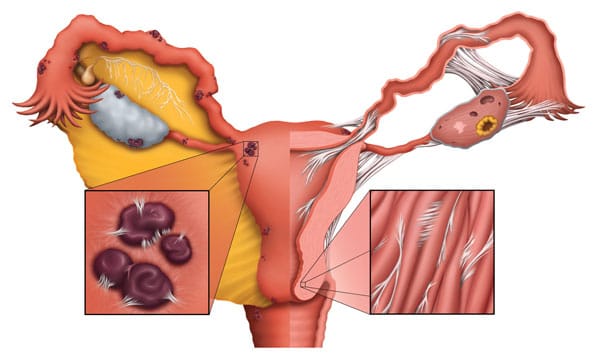
      You can see here that pelvic and abdominal adhesions can form all around the delicate structures of the body.
      • Surgery – Studies show that 55% to 100% of people who undergo pelvic surgery will develop pelvic adhesions. Cutting into the delicate tissues near your reproductive structures can result in a large amount of scar tissue growing around the healing site. Many of the women we treat for secondary infertility or chronic pelvic pain have undergone a prior C-section, hysterectomy, or appendectomy  (appendix removal).
      • Inflammation – Recurring inflammation is a very common cause of adhesions. Pelvic inflammatory disease (PID) is a major contributor to many of the infertility and pain cases we have treated. The constant inflammation causes scar tissue to grow in the pelvic area, often around the fallopian tubes or ovaries.
      • Infection/STIs – Sexually Transmitted Diseases (STDs) can lead to chronic infection and inflammation, which cause scar tissue to grow within the pelvis. The longer an infection or STD remains untreated, the more adhesions will form as the body attempts to surround and contain the infection. A major cause of blocked fallopian tubes is an untreated infection, as a result of chlamydia or gonorrhea.
      • Trauma – Contact sports, car accidents, falls, or work-related injuries are common traumas that can cause the formation of pelvic adhesions. Since the body’s first step in healing is to create adhesions to contain and isolate the injury, almost everyone has adhesions somewhere in their body.
      • Chronic conditions – Conditions that don’t have a definitive cure and recur periodically are considered chronic conditions. Two conditions responsible for a large portion of pelvic adhesions are polycystic ovarian syndrome (PCOS) and endometriosis. Both conditions share characteristics that result in adhesion formation. Chronic inflammation is explained in detail above, and abnormal growths within a woman’s reproductive tract are discussed. PCOS gets its name from the cysts that form on a woman’s ovary. Both the cysts and the surgeries needed to remove the cysts will cause adhesions. Endometriosis occurs when endometrial tissue forms outside of the uterus. Endometriomas and endometrial implants can become inflamed and cause scar tissue to form around the site, causing endometriosis infertility, period, or intercourse pain.
      • Radiation Therapy – We have treated many previous cancer patients for chronic pelvic pain because of radiation therapy. Radiation therapy is a treatment that can cause significant scarring and mechanical dysfunction inside a woman’s abdomen and pelvis. We often hear these patients describe their pain as a “stuck” or “tight” feeling that won’t go away.
      At left, we can see adhesions at sites of endometriosis. At right, adhesions are shown on the inside of the uterus and fallopian tubes, decreasing fertility. At the bottom, adhesions within the muscle of the cervix can cause pain with deep intercourse.

      Symptoms and Conditions Caused by Pelvic Adhesions

      • Blocked fallopian tubes – One of the most common forms of infertility caused by adhesions is blocked fallopian tubes. Adhesions wrap around delicate structures inside the reproductive tract, preventing the reproductive system from working normally. Adhesions can restrict the flow of sperm through the fallopian tubes, preventing the fertilization of an egg. Most physicians no longer perform surgery on these delicate structures because post-surgical adhesions tend to block the tubes once again when the body heals from the surgery.
      • Hydrosalpinx – Another common tubal blockage is a hydrosalpinx. This occurs when fluid collects in the fallopian tube – generally as the result of an infection. As adhesions form at the end of the tube closest to the ovary, the tube swells, much as your knee might swell after a knee injury. Hydrosalpinx usually indicates a totally blocked tube; in the rare case that the end is open, the sperm still tend to get lost in a large amount of fluid in the tube, greatly decreasing the chance for conception and increasing the chance for an ectopic pregnancy, in which the fertilized egg becomes stuck in the tube.
      • Unexplained infertility – Adhesions don’t show up on most diagnostic tests. In order to verify that a patient has adhesions, an exploratory surgery is required to directly visualize the adhesions. Unfortunately, since most patients are unaware of adhesions, the question is never asked: “Maybe my infertility is caused by adhesions?” This can lead to many women suffering from unexplained infertility.
      • Prior surgery – Surgeries are sometimes necessary to save a woman’s life, as in the case of an appendectomy. There may be less urgency to perform surgery in the case of undiagnosed pain. In these cases, a doctor may suggest doing an exploratory surgery to directly visualize the pelvic contents. Because adhesions form after most pelvic surgeries, the very surgery to correct a problem can be the cause of adhesion formation as the body heals.
      • Chronic pain – Stuck, tight, immobile, constantly uncomfortable. These are all common descriptions we hear from patients suffering from adhesions. Because adhesions bind to structures and create constant tension, it is no wonder that so many patients with adhesions also suffer from chronic pain.
      • Sexual dysfunction – Some non-surgical treatments are available for women with intercourse pain (dyspareunia) or other sexual dysfunction. Studies on our work in this area have shown that women have an increase in every measurable criterion of their sexual health (desire, orgasm, lubrication, pain, and arousal) after being treated for adhesions.

      Treatments for Pelvic Adhesions

      Experience relief from debilitating pelvic adhesions with Clear Passage® Physical Therapy’s Free Consult and Request Info – discover how their unique, non-surgical Clear Passage® Approach has helped countless women overcome infertility, chronic pain, and sexual dysfunction caused by internal scarring, without the risks of additional surgery or medication. To learn more, visit our Apply to Therapy page.

      Few options exist for treating pelvic adhesions. Many treatments are aimed at treating the symptoms of adhesions, rather than the adhesions themselves. Following the Hippocratic Oath that all physicians should adhere to, we have always believed that a natural, non-surgical, and drug-free approach should be the first step in the treatment of adhesions. Below are the options we see that have passed scientific scrutiny and been found to be effective, listed from safest to most invasive:

      • Manual Physical Therapy – A non-surgical, all-natural treatment plan is what we consider the best treatment for adhesions. Clear Passage® has been researching and treating patients with adhesions for over 25 years. The Clear Passage® Approach (CPA) is a hands-on therapy that focuses on detaching and weakening adhesions inside the body. Helping patients have natural pregnancies, live a pain-free life, and avoid future surgeries is our number one goal.

      If you or a woman you know is suffering from the symptoms above, we encourage you to complete a contact form or call us at 1-352-336-1433. You will be able to schedule a phone consultation with a member of our patient support team at no cost, and learn whether our non-surgical and drug-free treatment is right for you.

      • Pain Medications – The rise in chronic pain conditions has been met with a rise in pain medication prescriptions. The opioid epidemic is a well-known phenomenon in America. Pain medication simply masks pain; they do nothing to address the cause of the pain. They do not provide permanent solutions; further, they can lead to severe digestive issues along with addiction and dependency. Pain medications should be considered a temporary palliative measure while the patient searches for an actual treatment.
      • Surgery – Lysis (destruction) of adhesions by cutting or burning them during surgery is one of the most common ways to combat adhesion growth. Many surgeons note that this isn’t a permanent solution and often leads to more surgeries, because surgery is the number one cause of adhesions. Surgery also has risks, such as the risk of anesthesia, complications, or infection, and “inadvertent enterotomy,” in which a surgeon mistakenly cuts into or through an organ s/he had not intended to, in the crowded and adherent structures of the pelvis.
    • Patient Video: Two Miracle Babies and a New Body

      Patient Video: Two Miracle Babies and a New Body

      After having her first child, Jill was heartbroken when she found herself unable to get pregnant again. Her search for a non-surgical treatment for secondary infertility and endometriosis led her to Clear Passage® – and two more children! Today, she is a mother of three and free from endometriosis pain.

    • The Clear Passage® Insider – July 2016 Issue

      The Clear Passage® Insider – July 2016 Issue

      Patient Video: Two Miracle Babies and a New Body

      After having her first child, Jill was heartbroken when she found herself unable to get pregnant again. Her search for a non-surgical treatment for secondary infertility and endometriosis led her to Clear Passage® – and two more children! Today, she is a mother of three and free from endometriosis pain.

      Our Footprint Continues to Grow

      Clear Passage® now has clinics from California to the East Coast and the United Kingdom. It is incredibly gratifying to make our services more accessible for patients from all over the world. View all of our locations.

      Research Update

      Presenting Our Findings on SIBO (Small Intestinal Bacterial Overgrowth)

      Last month, we had the honor of presenting at the 2016 SIBO Symposium in Portland, Oregon. Clear Passage® founders Belinda Wurn, PT, and Larry Wurn, LMT, addressed an audience of several hundred physicians and researchers about our work treating SIBO with manual physical therapy. We are pleased that leading experts in the field continue to recognize the Clear Passage® Approach as an effective treatment to decrease the abdominal adhesions that can prevent patients with SIBO from achieving complete resolution of their symptoms.

      Five Clear Passage® Directors celebrate the strides we are making at the 2016 SIBO Symposium. From left to right: Julie Merkl, PT (Portland, OR), Neil Sturman, PT (Encinitas, CA), Clear Passage® founders Belinda Wurn, PT, and Larry Wurn, LMT (Gainesville, FL), and Leigh Hollowell, PT (San Francisco Bay).

      There Is Still Time to Join Our Small Bowel Obstruction Study

      We feel it is important for doctors and insurers to understand “quality of life” issues facing people who have had bowel obstructions. Thus, we are recruiting adults with a history of small bowel obstruction to participate in a research study, which consists of a questionnaire examining the impact of small bowel obstruction on overall quality of life. This study involves completing two online questionnaires, each of which requires approximately 30 minutes to complete.

      To be eligible to participate, you must:

      • have had a partial or full bowel obstruction in the last two years;
      • be between the ages of 18 and 90;
      • have had no cancer diagnoses in the last 10 years;
      • have not received treatment at Clear Passage® previously.

      What Patients Are Saying About Clear Passage®

      “As time passes, I become more grateful for the tremendous improvement in quality of life that I have experienced as a result of Michele’s work. I have more energy than I’ve had in years, and I am able to participate in many of the activities I had abandoned. I feel I have recovered the vibrant woman slumbering in survival mode inside me. The process also validated me at the core of my being; none of this was in my head, it turns out. Michele also taught me how to work on my remaining adhesions myself, which is necessary and crucial for long-term success.”

      – Vanessa

    • Two Natural Pregnancies After Secondary Infertility: NBC and Fox-TV Anchor Linda Vester’s Story

      Two Natural Pregnancies After Secondary Infertility: NBC and Fox-TV Anchor Linda Vester’s Story

      Click the video and hear Linda’s story.

      Linda Vester, a former NBC and Fox-TV anchor, talks about her struggle with secondary infertility and how Clear Passage® helped her achieve not one — but two — natural pregnancies.

      Transcription

      I’m Linda Vester. For many years, I was an anchor and correspondent for NBC News and then an anchor for the Fox News Channel. I’ve seen a lot around the world, seen a few war zones; I have to say that up until I tried to have children, I never felt such a sense of desperation – I tried to have kids and couldn’t. When I got married, we had Meredith really easily, and then I had something called secondary infertility – unexplained secondary infertility. Which is ‘medical speak’ for the doctors don’t know why you can’t have a baby. They just didn’t know. We tried IUI, timed intercourse, Clomid — but nothing. We did one IVF, and we got our son, and then after that, nothing worked. We tried it all again; we tried more IVFs and failed. The more we tried, the more I felt like a failure. I can’t tell you what it’s like to look around the neighborhood and see pregnant women everywhere, and it’s not you. That sense of failure — I know a lot of women feel it. The doctors just didn’t know why.

      So, I went on the Internet because I was determined to have another child with my husband, and I found Clear Passage®. They treated me in 2008 and, within one month, I was pregnant with our third child, and then right after that, pregnant naturally with our fourth. They gave us the babies we were yearning for, and I’m really grateful.

      I come from a long line of doctors, so I know my way around medicine. I can tell you it is particularly frustrating when conventional medicine runs out of options, and you’re trying to have a baby, knowing your time is running out. There are just limitations to conventional medicine when it comes to fertility – they have a limited bag of tricks. I was one of those women who were just not going to give up — I was going to stand on my head if that’s what it took to find a way to get pregnant. Luckily, I found Clear Passage® after searching on the Internet. It was nothing I’d ever heard of, but it made sense when they explained it to me, and it worked.

      So here I was, 43 years old, one month after being treated by Clear Passage, and then I was pregnant – after 43. Easy pregnancy, easy delivery. Right after that, pregnant naturally at 45 with our fourth child. It sounded a little unconventional, but it was a whole lot less expensive than the conventional IVF, and I was still willing to mix them both. For women who are on limited budgets, it’s a no-brainer. I mean, you could spend tens of thousands of dollars on in vitro, or you could spend a fraction of that getting therapy at Clear Passage®. Why not try it? One of the great things about getting treated at Clear Passage® is that once they opened up my reproductive area, I didn’t have to go back for IVF. I got pregnant with our third, and then at age 45, I got pregnant naturally with our fourth child. I didn’t have to go back for the expense and the pain of IVF.

      Do you have secondary or unexplained infertility? Request a phone consultation with a therapist, at no cost to you, to learn more about our therapy and whether it can help you.

      View more patient testimonial videos.

    • Mommy Blogger Seeks Alternative Therapy for Treating Secondary Infertility, Shares Intimate Details With Millions of Women Worldwide

      Mommy Blogger Seeks Alternative Therapy for Treating Secondary Infertility, Shares Intimate Details With Millions of Women Worldwide

      The all-natural, hands-only approach to the treatment of secondary infertility opens blocked fallopian tubes without surgery

      GAINESVILLE, FL – July 11, 2014 – Mommy Blogger, Akemi Fisher, 34, founder of MommyGuru.com, is seeking an all-natural, alternative therapy for treating secondary infertility at Clear Passage® Physical Therapy. Developed with physicians, scientists, and women’s health physical therapists, the holistic massage to the reproductive organs opens blocked fallopian tubes and enables infertile women to become pregnant.

      “I had no problem conceiving my daughter five years ago,” said Akemi, 34. “Now, at almost 35 years old, it’s not happening as quickly, so I decided to seek help. I’m hoping to help educate women on the options available by blogging about my experience in intimate detail. I will document my progress as a behind-the-scenes reporter.”

      The non-surgical treatment includes a protocol of manual physical therapy techniques, which have helped several hundred previously infertile women to conceive. It has been shown to open tubes in 61% of women with totally blocked fallopian tubes. Doctors recommend the five-day therapy as an adjunct or as a replacement for surgery to treat infertility, pelvic and intercourse pain, endometriosis, and blocked fallopian tubes.

      “We are looking forward to treating Akemi’s secondary infertility while she blogs about her experience and helps to educate women about alternative therapies available,” said Belinda Wurn, PT, Clinical Director and Founder of Clear Passage® Physical Therapy.

      The therapy has improved fertility for women with a variety of diagnoses, including endometriosis and hormonal conditions, by addressing the adhesions and mechanical factors that often cause or contribute to female infertility. Akemi will begin treatment on Wednesday, July 30th, at Clear Passage® Physical Therapy’s main office in Gainesville, FL.

      About Us – Clear Passage® Physical Therapy® is a network of physical therapy clinics specializing in the hands-on treatment of adhesions, female infertility, and chronic pain, with an additional focus on women’s health conditions such as endometriosis, pelvic and intercourse pain. Major medical journals and the public media have recognized Clear Passage® for its high success rates and ability to bypass the need for surgery and drugs. The group treats women from all over the world at their home office in Gainesville, Florida, or their clinics in Southern California, Denver, Indianapolis, Miami, and Washington, D.C.

    • Ten Clues to Solving Secondary Infertility

      Ten Clues to Solving Secondary Infertility

      Women who experience secondary infertility are often baffled by their diagnosis. “I was able to easily conceive before,” many women tell us. “Why am I now having trouble?”

      When our therapists examine women with secondary infertility, they look for ten key changes:

      1. C-Section – Did the patient have a C-section? Adhesions and scar tissue after a C-section can cause blocked fallopian tubes or prevent proper implantation
      2. Episiotomy – Did the patient have an episiotomy? An episiotomy scar can cause adhesions that extend into the vagina and cervix, causing the cervix to become stiffened and preventing the passage of sperm
      3. Hormonal Changes – Has the patient had her hormone levels checked since giving birth? Has the patient’s period changed in heaviness or number of days? Pregnancy and aging can cause hormones to change, which may cause infertility
      4. Surgeries – Did the patient undergo any surgeries since pregnancy? Surgeries can cause adhesions to form and impair fertility
      5. Trauma – Has the patient experienced any car accidents, falls, abuse, or similar traumatic events? These events can cause long-lasting injuries, pelvic imbalances, adhesion formation, and other factors that can negatively impact fertility
      6. Infection – Has the patient had any bladder, vaginal, or yeast infections since pregnancy? Infections can cause adhesions to form in the delicate structures of the female pelvis. These adhesions can impair female fertility in multiple ways
      7. Inflammation – Has the patient been diagnosed with any new inflammatory conditions, such as endometriosis or PID? Inflammation directly causes adhesion formation, which can lead to infertility
      8. Pelvic or Back Pain – Has the patient experienced any hip, back, or pelvic pain since pregnancy? Pain is a sign that something is wrong. Pain in the pelvis may be linked to infertility, such as a hip injury that is located near the fallopian tubes.
      9. Sexual Dysfunction or Intercourse Pain – Has the patient experienced any sexual dysfunction or intercourse pain since pregnancy? Any problems with decreased desire, arousal, lubrication, orgasm, or satisfaction are signs that adhesions have formed in the delicate structures of the reproductive tract, possibly causing infertility
      10. Ovulation or Menstrual Pain – Has the patient experienced any new ovulation or menstrual pain since pregnancy? Ovulation pain is a sign that adhesions may be restricting and impairing the proper function of the ovary. New menstrual pain is a sign that adhesions may have formed around the uterus, preventing proper implantation.