
Category: Unexplained Infertility

  • Unexplained Infertility

    Unexplained Infertility

    We Treat Unexplained Infertility Naturally

    The diagnosis of unexplained infertility is often due to adhesions – small yet powerful internal scars that do not appear in medical diagnostic tests. Clear Passage® is a world leader, with over three decades of experience treating adhesions and unexplained female infertility, as a complement to regular gynecologic care. Studies in peer-reviewed U.S. and international medical journals found that our manual physio/physical therapy improved fertility for most women. 

    Complete the online Request Consultation form to receive a free phone consultation with an expert therapist and learn more.

    Causes and Frequency of Unexplained Infertility

    Unexplained infertility (UI), also called “idiopathic infertility,” is one of the most frequent diagnoses in reproductive medicine. (Gleicher & Barad, 2006)

    There is always a cause for infertility, so when a diagnosis shows “no visible cause,” we turn to common “invisible” causes – those that often do not appear in X-rays, ultrasounds, MRI, or CT scans. Perhaps the most common of these invisible causes is adhesions.

    The delicate female reproductive organs can lose function due to adhesive bonds. Adhesions are composed of strong but small (sometimes microscopic) bands of collagen fibers. After surgery, injury, or inflammation, such as endometriosis, adhesions form to start the healing process. Where they form, they create tiny but powerful bonds that can attach like glue to delicate pelvic and reproductive structures. At Clear Passage®, we find adhesions to be a major problem in most of our patients diagnosed with unexplained infertility. Adhesions can cause infertility or pain as they constrict the reproductive organs in adhesive “straitjackets,” decreasing the chance of implantation or causing a miscarriage.

    Adhesions that are located near the reproductive tract can impact fertility in numerous ways. Examples include:

    • Adhesions on the uterine walls and ligaments can cause uterine spasms or inflammation, preventing implantation or causing miscarriage.
    • Adhesions within the tissues of the cervix can cause stenosis of the cervix, which causes the cervix to close (stenosis), stiffen (fibrosis), or spasm, thus impeding the passage of sperm into the uterus.
    • Adhesions on the surface of the ovaries can prevent an egg from being released.
    • Adhesions in or near the fallopian tube can restrict or prevent sperm and egg from meeting, preventing conception.

    We encourage women with unexplained infertility to examine their personal and medical history for past healing events that may have caused pelvic adhesions. These include:

    • Surgery (any surgery to the pelvis, abdomen, hip, or back, etc.)
    • Infection (e.g., vaginal, bladder, yeast, etc.)
    • Inflammation (e.g., endometriosis, chlamydia, pelvic inflammatory disease (PID), etc.)
    • Trauma (fall onto tailbone, back, or hip, physical or sexual abuse, car accident, etc.)
    At a microscopic level, tiny but powerful cross-links form to create adhesions that can cause infertility as they constrict the reproductive organs in adhesive “straitjackets,” decreasing the chance for implantation or causing a miscarriage. When we dissolve or detach the underlying chemical bonds, adhesions appear to pull apart, like clearing the run in a sweater.

    Symptoms of Unexplained Infertility

    Some symptoms that accompany unexplained infertility include: 

    • Negative finding for male factor infertility
    • Inability to determine the hormonal cause of infertility
    • Inability to diagnose mechanical failure of the reproductive tract
    • Failure to conceive after 12 months of sexual activity without contraception

    Treatments for Unexplained Infertility

    Clear Passage® Treatment

    After reviewing your history of healing events, we conduct a thorough evaluation of your entire body. We palpate for areas of tension or restricted mobility, with particular attention to areas of prior surgery, trauma, infection, or inflammation. We educate you and invite you to become a valued member of your treatment team. Then we begin therapy, using our hands to find, reduce, and eliminate the adhesions, bond by bond, to return your organs to previous mobility, increase functionality, and improve fertility. With over three decades of published results on the effectiveness of manually treating infertility by addressing adhesions, Clear Passage® Physical Therapy is seen as a ‘gold standard’ for natural infertility treatment. 

    Because adhesions do not appear on diagnostic tests, they are a frequent cause of unexplained infertility. We encourage you to examine your medical history for past healing events (surgery, injury, infection). These cause the adhesions that often result in infertility.

    No medical technique has a 100% success rate. If we are unable to open your tubes, your chances for a successful IVF performed within 15 months after therapy increase by roughly 50%, per published studies. View our success rates.

    Other Treatment Options (Surgery, Drugs)

    Before the Clear Passage® Approach, lysis of adhesions was the only documented choice medical science offered for treating adhesions. This involves cutting or burning the adhesions under general anesthesia via laparoscopy or laparotomy (open surgery).

    While lysis of adhesions can be effective, the surgery has some drawbacks:

    • It carries risks associated with anesthesia or infection.
    • Because adhesions can prevent the ability to see underlying structures, surgeons can mistakenly cut or burn unintended organs or other structures.
    • The body tends to create more adhesions as it heals from the very surgery designed to remove them.

    Click here to watch an Internet video in which the physician removes adhesions in a woman who has had several prior surgeries (graphic).

    Post-surgical adhesions were the focus of a large, ten-year study. The Lancet, a leading medical journal, reported that 35% of all open abdominal or pelvic surgery patients were readmitted to the hospital more than twice to treat post-surgical adhesions during the 10 years after their original surgery. (Ellis et al., 1999) Many follow-up surgeries (22%) occurred in the first year after surgery, and “readmissions continued steadily throughout the 10-year period,” the study noted.

    Laparoscopy allows physicians to see the condition of the reproductive organs but the surgery itself can cause adhesions to form.

    A large study published in Digestive Surgery showed that more than 90% of patients develop adhesions following open abdominal surgery, and 55% to 100% of women develop adhesions following pelvic surgery. (Liakakos et al., 2001) Small bowel obstruction, infertility, chronic abdominal and pelvic pain, and difficult reoperative surgery are the most common consequences of abdominal and pelvic adhesions. Despite elaborate efforts to develop effective strategies to reduce or prevent adhesions, their formation remains a frequent occurrence after abdominal surgery. (Liakakos et al., 2001) Thus, many patients become trapped in a cycle of surgery-adhesions-surgery, with no end in sight. Clear Passage® ends this repeating cycle for most patients. 

    Published Research – Clear Passage®

    To view published results on the Clear Passage® Approach in treating infertility, please view our Infertility Success Rates Page. 

    Testimonials

    To read patient success stories, please visit our Infertility Testimonial page. 

    Related Content:

    Diet

    Ectopic Pregnancy

    Sexual Dysfunction

    General Info

  • What You Need to Know About Pelvic Adhesions

    What You Need to Know About Pelvic Adhesions

    What are Pelvic Adhesions?

    Many women are not receiving the education needed from their doctors about adhesions. Very few women even know they have adhesions. Most commonly known as “scar tissue,” adhesions are simply scar tissue that forms inside the body. Once formed, the body has no way to deal with the scar tissue, so it will remain in place and sometimes spread to neighboring structures.

    Adhesions consist of tiny strands of collagen that form around injured tissue as the body’s first step in the process of healing. Common areas of adhesion formation are areas affected by a prior infection, inflammation, or endometriosis. Pelvic adhesions can lead to a host of female health problems, ranging from infertility to chronic pain, including pain with intercourse. If you’ve had any kind of surgery, infection, injury, or endometriosis, there’s a good chance you have adhesions. We made a short guide that can help you figure out if you have adhesions after surgery.

    What Causes Pelvic Adhesions?

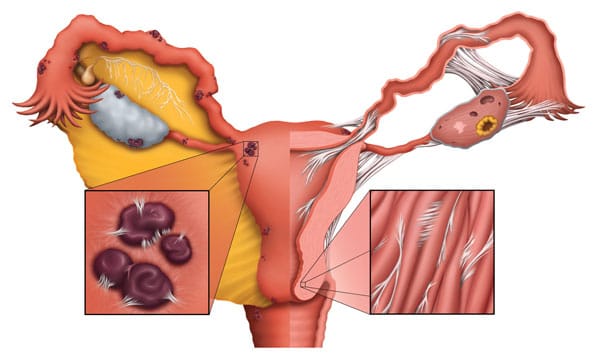
    You can see here that pelvic and abdominal adhesions can form all around the delicate structures of the body.
    • Surgery – Studies show that 55% to 100% of people who undergo pelvic surgery will develop pelvic adhesions. Cutting into the delicate tissues near your reproductive structures can result in a large amount of scar tissue growing around the healing site. Many of the women we treat for secondary infertility or chronic pelvic pain have undergone a prior C-section, hysterectomy, or appendectomy  (appendix removal).
    • Inflammation – Recurring inflammation is a very common cause of adhesions. Pelvic inflammatory disease (PID) is a major contributor to many of the infertility and pain cases we have treated. The constant inflammation causes scar tissue to grow in the pelvic area, often around the fallopian tubes or ovaries.
    • Infection/STIs – Sexually Transmitted Diseases (STDs) can lead to chronic infection and inflammation, which cause scar tissue to grow within the pelvis. The longer an infection or STD remains untreated, the more adhesions will form as the body attempts to surround and contain the infection. A major cause of blocked fallopian tubes is an untreated infection, as a result of chlamydia or gonorrhea.
    • Trauma – Contact sports, car accidents, falls, or work-related injuries are common traumas that can cause the formation of pelvic adhesions. Since the body’s first step in healing is to create adhesions to contain and isolate the injury, almost everyone has adhesions somewhere in their body.
    • Chronic conditions – Conditions that don’t have a definitive cure and recur periodically are considered chronic conditions. Two conditions responsible for a large portion of pelvic adhesions are polycystic ovarian syndrome (PCOS) and endometriosis. Both conditions share characteristics that result in adhesion formation. Chronic inflammation is explained in detail above, and abnormal growths within a woman’s reproductive tract are discussed. PCOS gets its name from the cysts that form on a woman’s ovary. Both the cysts and the surgeries needed to remove the cysts will cause adhesions. Endometriosis occurs when endometrial tissue forms outside of the uterus. Endometriomas and endometrial implants can become inflamed and cause scar tissue to form around the site, causing endometriosis infertility, period, or intercourse pain.
    • Radiation Therapy – We have treated many previous cancer patients for chronic pelvic pain because of radiation therapy. Radiation therapy is a treatment that can cause significant scarring and mechanical dysfunction inside a woman’s abdomen and pelvis. We often hear these patients describe their pain as a “stuck” or “tight” feeling that won’t go away.
    At left, we can see adhesions at sites of endometriosis. At right, adhesions are shown on the inside of the uterus and fallopian tubes, decreasing fertility. At the bottom, adhesions within the muscle of the cervix can cause pain with deep intercourse.

    Symptoms and Conditions Caused by Pelvic Adhesions

    • Blocked fallopian tubes – One of the most common forms of infertility caused by adhesions is blocked fallopian tubes. Adhesions wrap around delicate structures inside the reproductive tract, preventing the reproductive system from working normally. Adhesions can restrict the flow of sperm through the fallopian tubes, preventing the fertilization of an egg. Most physicians no longer perform surgery on these delicate structures because post-surgical adhesions tend to block the tubes once again when the body heals from the surgery.
    • Hydrosalpinx – Another common tubal blockage is a hydrosalpinx. This occurs when fluid collects in the fallopian tube – generally as the result of an infection. As adhesions form at the end of the tube closest to the ovary, the tube swells, much as your knee might swell after a knee injury. Hydrosalpinx usually indicates a totally blocked tube; in the rare case that the end is open, the sperm still tend to get lost in a large amount of fluid in the tube, greatly decreasing the chance for conception and increasing the chance for an ectopic pregnancy, in which the fertilized egg becomes stuck in the tube.
    • Unexplained infertility – Adhesions don’t show up on most diagnostic tests. In order to verify that a patient has adhesions, an exploratory surgery is required to directly visualize the adhesions. Unfortunately, since most patients are unaware of adhesions, the question is never asked: “Maybe my infertility is caused by adhesions?” This can lead to many women suffering from unexplained infertility.
    • Prior surgery – Surgeries are sometimes necessary to save a woman’s life, as in the case of an appendectomy. There may be less urgency to perform surgery in the case of undiagnosed pain. In these cases, a doctor may suggest doing an exploratory surgery to directly visualize the pelvic contents. Because adhesions form after most pelvic surgeries, the very surgery to correct a problem can be the cause of adhesion formation as the body heals.
    • Chronic pain – Stuck, tight, immobile, constantly uncomfortable. These are all common descriptions we hear from patients suffering from adhesions. Because adhesions bind to structures and create constant tension, it is no wonder that so many patients with adhesions also suffer from chronic pain.
    • Sexual dysfunction – Some non-surgical treatments are available for women with intercourse pain (dyspareunia) or other sexual dysfunction. Studies on our work in this area have shown that women have an increase in every measurable criterion of their sexual health (desire, orgasm, lubrication, pain, and arousal) after being treated for adhesions.

    Treatments for Pelvic Adhesions

    Experience relief from debilitating pelvic adhesions with Clear Passage® Physical Therapy’s Free Consult and Request Info – discover how their unique, non-surgical Clear Passage® Approach has helped countless women overcome infertility, chronic pain, and sexual dysfunction caused by internal scarring, without the risks of additional surgery or medication. To learn more, visit our Apply to Therapy page.

    Few options exist for treating pelvic adhesions. Many treatments are aimed at treating the symptoms of adhesions, rather than the adhesions themselves. Following the Hippocratic Oath that all physicians should adhere to, we have always believed that a natural, non-surgical, and drug-free approach should be the first step in the treatment of adhesions. Below are the options we see that have passed scientific scrutiny and been found to be effective, listed from safest to most invasive:

    • Manual Physical Therapy – A non-surgical, all-natural treatment plan is what we consider the best treatment for adhesions. Clear Passage® has been researching and treating patients with adhesions for over 25 years. The Clear Passage® Approach (CPA) is a hands-on therapy that focuses on detaching and weakening adhesions inside the body. Helping patients have natural pregnancies, live a pain-free life, and avoid future surgeries is our number one goal.

    If you or a woman you know is suffering from the symptoms above, we encourage you to complete a contact form or call us at 1-352-336-1433. You will be able to schedule a phone consultation with a member of our patient support team at no cost, and learn whether our non-surgical and drug-free treatment is right for you.

    • Pain Medications – The rise in chronic pain conditions has been met with a rise in pain medication prescriptions. The opioid epidemic is a well-known phenomenon in America. Pain medication simply masks pain; they do nothing to address the cause of the pain. They do not provide permanent solutions; further, they can lead to severe digestive issues along with addiction and dependency. Pain medications should be considered a temporary palliative measure while the patient searches for an actual treatment.
    • Surgery – Lysis (destruction) of adhesions by cutting or burning them during surgery is one of the most common ways to combat adhesion growth. Many surgeons note that this isn’t a permanent solution and often leads to more surgeries, because surgery is the number one cause of adhesions. Surgery also has risks, such as the risk of anesthesia, complications, or infection, and “inadvertent enterotomy,” in which a surgeon mistakenly cuts into or through an organ s/he had not intended to, in the crowded and adherent structures of the pelvis.