
Experience relief from bowel obstructions with Clear Passage® Physical Therapy’s Free Consult and Request Info, offering a non-surgical, manual therapy approach that treats adhesions – the primary cause of most small bowel obstructions – potentially helping you avoid risky surgeries and recurrent blockages. To learn more about applying for therapy, visit our Apply to Therapy page.
Table of Contents
What is a bowel obstruction?
An intestinal obstruction, also known as a bowel obstruction or bowel blockage, occurs when food or liquid is unable to pass through either the large or small intestine. If left untreated, life-threatening complications such as tissue death or infection, even death, can occur.
Tissue death occurs when the intestinal obstruction cuts off the blood supply to a section of your intestine and causes the tissue to die. The dead tissue weakens your intestinal wall, which can lead to a tear, allowing the contents of the bowel to spread throughout the abdomen, a condition called Peritonitis. This infection that occurs deep within the abdomen is life-threatening. Surgery, along with direct application of antibiotics to the infected internal sites, is often required to save the patient’s life.

Symptoms of a bowel obstruction or bowel blockage
- Nausea and vomiting
- Constipation and inability to pass gas
- Abdominal distention, which can be confused with bloating
- Fever
- Tachycardia, which is a heart rate that exceeds the normal resting rate
- Loss of appetite
- Recurring abdominal pain
Causes of mechanical bowel obstructions
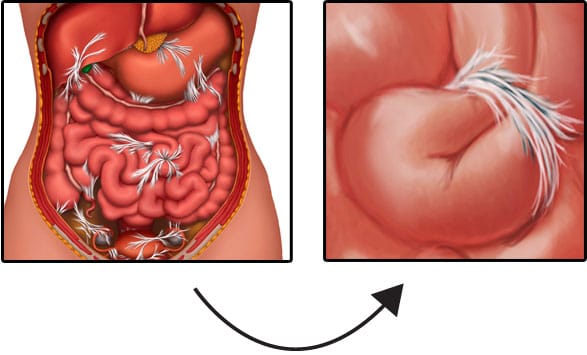
Adhesions: The most common cause of small bowel obstruction is intra-abdominal adhesions. Adhesions caused by abdominal or pelvic surgery cause about 65% to 75% of all small bowel obstructions. Adhesions are scar tissue that can form after infection, radiation therapy, inflammation, and most commonly, surgery. One of the reasons recurring bowel obstructions are so difficult to treat is that obstructions and blockages are often treated with surgery. Post-surgical adhesions can wrap around the intestine and squeeze it shut, similar to pinching a garden hose. In other cases, a stricture (narrowing) can occur, preventing liquids and food from passing through.
Hernias: When the intestine protrudes through an opening in the abdominal wall, it is called a hernia. Hernias can squeeze the bowel shut, making it difficult or impossible for contents to pass through the intestine. This causes impacted stool, a stricture, or a blockage to occur.
Crohn’s disease: This is a chronic inflammatory bowel disease that causes inflammation in the lining of the digestive tract. The constant inflammation leads to scarring and the formation of adhesions.
Malignancy: This is defined as the presence of a malignant tumor (cancer). A tumor can obstruct the intestine, causing a blockage.
Volvulus: This is an obstruction caused by the intestine being twisted or knotted. Once the intestine is twisted or knotted, nothing can pass through. This condition can also obstruct blood flow, causing tissue death.
Diverticulitis: Similar to Crohn’s disease, diverticulitis is an inflammation or infection in the small pouches of the digestive tract that can lead to scar tissue and constipation.
Food that can cause bowel obstructions
You may be wondering what food you can safely eat with a bowel obstruction. Here are some foods to avoid if you have been diagnosed with a bowel obstruction.
- Fruits with a cellulose structure can cause or contribute to an obstruction. One of the most common fruits reported to cause intestinal obstructions is the persimmon, though a large number of cases have been reported with citrus fruits in general and other dried fruits.
- Dried nuts and seeds.
- Whole grain or other high-fiber breads.
- Tough or stringy pieces of meat.
Bowel obstruction prevention
- Drink plenty of fluids – It is generally suggested that individuals drink 6 to 8 cups of water each day. Water helps food move more easily through the digestive tract.
- Chew your food thoroughly – Not chewing food well increases the amount of work your digestive tract must do and can contribute to intestinal obstructions.
- Clear Passage® – A manual physical therapy that treats the adhesions causing recurring bowel obstructions – without surgery or drugs. By avoiding surgery, patients can often avoid repeat bowel obstructions because surgery is the primary cause of adhesions and bowel obstructions.
- Diet change – Changing your diet may help prevent future bowel obstructions.

Bowel obstruction treatment
Fasting – Allows the bowel to rest and helps reduce the risk of complications during surgery, if that becomes necessary.
Nasogastric intubation – An “NG Tube” is a tube that carries food and medicine down the throat and into the stomach, and also pumps out excess stomach liquids in an effort to decompress the bowel.
Surgery – Surgery may be required to remove infected or necrotic (dead) tissue or to repair perforations to the bowel.
Click here to learn more about a non-surgical treatment option for bowel obstruction.
References
- http://emblog.mayo.edu/2015/01/04/the-truth-about-small-bowel-obstruction/
- http://www.sciencedirect.com/science/article/pii/0002961062903756
- https://www.mayoclinic.org/diseases-conditions/intestinal-obstruction/symptoms-causes/syc-20351460
- https://emedicine.medscape.com/article/774140-overview
- https://www.livestrong.com/article/313014-bowel-blockage-diet/
“If the information in this article sounds like it may relate to what you’re experiencing, the team at Clear Passage® Physical Therapy is here to help. Many people living with this condition simply want to know if there is a natural treatment option without drugs or surgery that could work for them. The good news is you don’t have to figure it out alone. You can request more information to speak with a knowledgeable team member who will review your situation and help you understand whether this specialized therapy may be a good fit. If you’re ready to move forward, you can also apply for therapy so the clinical staff can carefully review your health history and determine the best path toward relief. Taking a few minutes to reach out could be the first step toward getting answers—and possibly getting your life back.”
Comments
9 responses to “The Most Common Causes of Bowel Obstruction and How to Prevent It”
I’m having problems having a bowel movements and I was wondering what can I do I have knots in my neck and up under my left side of my arm by my heart what can I do to stop this it’s very painful trying to get rid of gas and to have a regular bowel movement on a regular basis
Hi Harvey,
Without your complete medical history, we are unable to recommend treatment. Please fill out a contact form and a medical history form. A member of our patient resources team will contact you and answer questions about our therapy and how we can help your condition.
https://clearpassage.com/contact/
Best,
The Clear Passage® Team
I have scar tissue on my lower intestine I was informed by my gynecologist I’m not sure if it’s from prior surgery for umbilical hernia.
Please advise if you have partners in Cape Town South Africa who offer the same treatment. Patient history hysterectomy including ovaries and endometriosis excision resulting in scar tissue that have caused bowel obstruction.
Hi Zena,
Our patients take a few days to travel to one of our locations for a self-healing retreat; most receive our full program in just five days. Patients travel from around the world for this, as they have for over 20 years. You can learn about all of our locations at this link: https://clearpassage.com/who-we-are/locations/
Please feel free to contact us directly at info@clearpassage.com and 1-352-336-1433, or via the following online contact form if you have any additional questions.
https://clearpassage.com/contact/
Best,
The Clear Passage® Team
Do you have therapists trained in your techniques in offices other than listed?
Hi Angela,
All of our therapists appear on our therapists and locations pages.
https://clearpassage.com/who-we-are/therapists/
https://clearpassage.com/who-we-are/locations/
Best,
The Clear Passage® Team
I had cancer of the rectum 5 years ago and have an colostomy. i It is now determined that I have a partial bowel obstruction. I am interested in trying the physical thepary. I live in Bend, Oregon is this thepary available in this area, Portland included. Thanks Mary Whitcomb
Hi Mary,
Our closest location to you would be in California.
Please feel free to contact us directly at info@clearpassage.com and 1-352-336-1433, or via the following online contact form if you have any additional questions.
https://clearpassage.com/contact/
Best,
the Clear Passage® Team